
- Menu
- Desks
- Seating
- Tables
- Customer Service
- 1.888.719.4960
The upfront cost difference between porcelain and melamine is real, but so is the performance difference. Here's a straight comparison so you can decide whether the savings on a melamine board actually make sense for your room and how you use it.
Quick Verdict
For any room where the whiteboard gets regular daily use, porcelain is the right buy — the surface holds up over years of heavy use without ghosting or degradation, and the long-term cost per year of use is actually lower than replacing melamine boards when they wear out. Melamine makes sense for back-office spaces and personal offices where use is occasional and light. Don't put a melamine board in a busy conference room and expect it to last.
| Feature / Factor | Porcelain Whiteboard | Melamine Whiteboard |
|---|---|---|
| Typical Size Range | 3’×4’ to 4’×8’ and larger | Available across common board sizes from compact to room-scale |
| Approx. Weight | 25–90 lbs depending on size and frame | Generally lighter than porcelain equivalents |
| Writing Surface | Baked porcelain enamel on steel — extremely hard and non-porous | Painted composite surface — porous at the microscopic level |
| Ghosting Resistance | Excellent — surface resists ghosting even under intensive daily use | Poor under heavy use — ghost images develop as surface wears |
| Stain Resistance | Excellent — markers erase cleanly even after extended contact | Moderate — markers can stain if left on the surface for hours |
| Magnetic Function | Yes — steel core accepts magnets | Typically no — wood/composite backing is not magnetic |
| Best For | Daily use in conference rooms, training rooms, classrooms, and operations spaces | Light-duty use in private offices, break rooms, and back-office spaces |
| Surface Lifespan | 10+ years under heavy daily use | 1–3 years under heavy use before ghosting becomes a persistent problem |
| Maintenance | Easy to keep clean even with heavy marker use | Requires more consistent cleaning; periodic deep cleaning helps |
| Long-Term Value | One of the best long-term values in collaborative writing surfaces | Good short-term value; weaker cost-per-year under heavy use |
A common misconception is that porcelain and melamine whiteboards are essentially the same product at different price points — just buy the cheaper one and save money. In practice, the surface materials behave so differently under regular use that they're really separate products serving different needs.
Porcelain enamel is a glass-like material fused to steel at extremely high temperatures. The result is a surface that is non-porous, extremely hard, and chemically inert — dry-erase marker ink sits on top of it and wipes off completely. The steel core gives most porcelain boards their magnetic function as a bonus. The board you mount in a conference room today can still look and perform like new a decade from now with normal care.
Melamine is a painted composite surface. It starts out looking decent and writing reasonably well, but the surface is microporous. With repeated marker use and erasing, ink compounds work into those microscopic pores and create ghost images that no eraser fully removes. This process accelerates with heavy use — a busy training room can degrade a melamine board in under a year. You can clean it with whiteboard restoration products and extend the usable life, but you're working against the material rather than with it.
If the board is going on the wall of a conference room that runs two or three meetings a day, a training room with daily sessions, a classroom, or any space where multiple people use the board frequently — porcelain is the right specification. The board will perform at a professional level for years without the frustration of ghost images, staining, or the awkward conversation about why the meeting room board looks terrible.
Porcelain's magnetic function also has real practical value that's easy to overlook when comparing specs. Being able to clip a document, a printed diagram, or a reference sheet to the board with a magnet means the board works as both a writing surface and a display surface — that dual function simplifies meetings without requiring a second board or a tackable surface nearby.

Porcelain Steel Whiteboard 4ft x 4ft by Ghent
View & OrderMelamine is a legitimate choice in the right application. A private office where the board gets used once or twice a week for quick personal notes — a phone number, a task list, a calculation — can use a melamine board without significant issues for several years. A break room where employees occasionally jot down shift notes or reminders is a reasonable application. A temporary office or a workspace that won't be occupied long enough for the surface to degrade is another good fit.
Where melamine fails is any environment with regular, heavy, multi-user use. Don't put a melamine board in a shared conference room or a classroom and expect it to deliver the same clean writing experience month after month. The surface will let you down faster than you expect, and the cost of replacing it cancels out whatever you saved upfront.
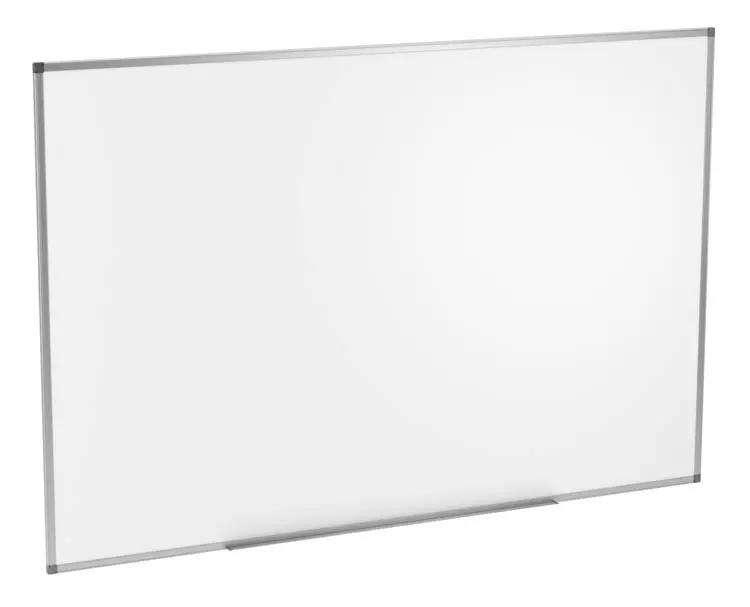
Melamine Whiteboard 4ft x 8ft by Coaster Fine Furniture
View & OrderPorcelain boards cost more upfront than melamine, but that gap often looks different when you extend the math. A melamine board that costs less but needs replacement every two to three years under heavy use can end up costing more over a decade than a single porcelain board that's still performing cleanly after ten years. Add in the time and hassle of ordering a replacement, clearing the old board off the wall, and reinstalling — and the melamine savings start to shrink further.
We always recommend being honest about how a board will actually be used before making the call. If use is genuinely light and the room has a modest budget, melamine is fine. If the room is a working conference space and the board matters to meeting productivity, the porcelain investment is the more sensible purchase over a realistic ownership horizon.
For conference rooms, training rooms, classrooms, and any shared workspace with regular daily use, porcelain is the right whiteboard — full stop. The surface performance is in a different category from melamine, the magnetic function adds practical value, and the long-term cost per year of use justifies the initial investment. For light-use applications like private offices and back-of-house spaces, melamine does the job without paying for more board than you need. Shop boards and easels at FindOfficeFurniture.com or call us and we'll help you match the right surface to the right room and budget.
Shop Boards & Easels at FindOfficeFurniture.comPorcelain uses a baked enamel coating fused to a steel substrate — the resulting surface is extremely hard and non-porous, which means dry-erase markers erase cleanly with minimal residue and the surface resists staining even when markers are left on for extended periods. Melamine uses a painted composite surface that is porous at a microscopic level. That porosity means marker ink can work its way into the surface over time, creating ghost images that don't fully erase. In a conference room with daily use, that difference becomes visible within months.
Under moderate use — a couple of sessions per week with proper dry-erase markers and consistent cleaning — a melamine board can look acceptable for one to two years. Under heavy daily use in an active conference room or training space, ghosting and surface degradation can become noticeable in as little as six to twelve months. Porcelain boards under the same heavy-use conditions can look clean and perform like new for ten years or more.
Most melamine whiteboards are not magnetic. Melamine is typically applied to a wood composite or lightweight fiberboard backing that has no magnetic properties. Porcelain whiteboards, by contrast, are almost always magnetic because the enamel surface is bonded to a steel substrate — magnets attach readily and hold securely. If you need a magnetic writing surface and are considering a melamine board to save money, the lack of magnetic function is a real limitation worth factoring into the decision.
You can improve a ghosted melamine surface with a dedicated whiteboard restoration cleaner or by applying isopropyl alcohol with a soft cloth, and in mild cases this removes residue effectively. But once the surface itself has been penetrated by marker ink — which happens progressively under heavy use — no cleaning solution fully restores it. The surface is simply worn out. Porcelain boards don't experience that kind of irreversible degradation under normal use, which is why facilities managers who have dealt with replacement cycles often specify porcelain from the start.
Yes — melamine is a reasonable choice for rooms with very occasional use, such as a private office used mainly for quick personal notes, a break room with light writing activity, or a temporary space where the board won't be around long enough for the surface degradation to matter. For any room where the whiteboard is a genuine daily working tool for a team, the extra investment in porcelain pays for itself by eliminating the frustration and replacement cost that come with a worn melamine surface.