
- Menu
- Desks
- Seating
- Tables
- Customer Service
- 1.888.719.4960
Two finishes that can look similar in a catalog but carry very different expectations once they're in your space. Here's the honest comparison so you can decide with confidence before delivery day.
Quick Verdict
For most conference rooms, the laminate table is the smarter buy — it handles daily use well, costs less, and stays sharp for years without much fuss. Veneer belongs in executive boardrooms where the quality of the finish is part of the message you're sending. Be honest about the room's actual purpose and pick accordingly.
| Feature / Factor | Laminate Conference Table | Veneer Conference Table |
|---|---|---|
| Typical Length | 8′–14′, high-pressure or thermally fused surface | 8′–16′, real wood veneer over engineered substrate |
| Approx. Weight | 180–500 lbs depending on base style and length | 220–600 lbs |
| Best For | Organizations that need professional meeting furniture with strong durability and manageable cost | Executive meeting rooms where finish quality is part of the brand statement |
| Surface Strength | Resists scratches, heat, and stains well under daily use | Rich and warm but needs careful handling to preserve the finish |
| Maintenance | Wipe-and-go — forgiving under frequent use | Requires periodic conditioning and protection from moisture |
| Accessories | Available with power modules, boat shapes, and varied base configurations | Pairs beautifully with matching veneer casegoods and credenzas |
| Visual Profile | Clean and contemporary | Rich, warm, and boardroom-oriented |
| Installation | Routine commercial install; plan for room access on large sizes | Best treated as a premium room installation with experienced handlers |
| Space Planning | Works in most standard conference room footprints | Belongs in rooms designed around leadership meetings and presentations |
| Long-Term Value | Excellent across most commercial environments | Excellent when premium finish is genuinely part of the business case |
The core distinction isn't just about how the table looks — it's about what the surface can withstand and what signal it sends to the people sitting around it. Laminate conference tables are built from layers of resin-saturated paper bonded under heat and pressure, producing a surface that holds up extremely well to the kind of wear a busy conference room generates: marker bleed-through from whiteboards, coffee cups, laptops dragged across the top, and dozens of meetings per week. It cleans easily, it doesn't need seasonal conditioning, and it doesn't show wear the way softer materials do.
Veneer is a different story. A thin slice of genuine wood — walnut, cherry, mahogany, or another species — is bonded to an engineered wood substrate and then finished with lacquer or polyurethane. The result is genuinely beautiful in the right room: the grain has depth and variation you can see and feel that no laminate perfectly replicates. But that beauty comes with responsibility. Veneer is more sensitive to heat, moisture, and abrasion, and the finish can be damaged in ways that are expensive to repair properly.
The laminate table earns its place in any conference room that sees real, recurring use. Daily team meetings, client presentations, training sessions, working lunches — all of that is exactly what laminate is built for. It handles the volume without complaining and keeps looking sharp without much from you in return. It's also the right call when you're furnishing multiple conference rooms and need consistency across the building: laminate finishes are reliably repeatable, easy to spec across different vendors, and far easier to replace or match if a piece is ever damaged.
Laminate is also a smarter buy for organizations watching the budget line. The savings compared to veneer are real, and those dollars can go toward better chairs, a power/data module in the table, or a quality credenza that completes the room. If you're building out a whole suite, that flexibility matters.
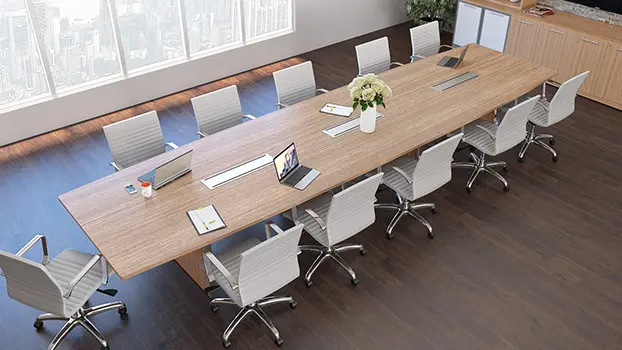
Conference Table 14ft Boat Shaped by Corp Design
View & OrderVeneer belongs where appearance is doing real work for the organization. The boardroom where the company brings in major clients, the executive conference suite that partners and investors see on the first visit, or any room where the quality of the furniture is part of the credibility signal — these are the right applications for veneer. When you walk someone into a room with a genuine wood veneer table, the message is different from laminate. It communicates investment and care in a way that people with discerning eyes will notice.
Just be realistic about maintenance before committing. Veneer in a daily team room that gets used hard is going to show wear, and refinishing a conference table is a project, not a quick fix. If the room gets used by the whole company five days a week, laminate will serve you better long-term even if veneer looks better at purchase.
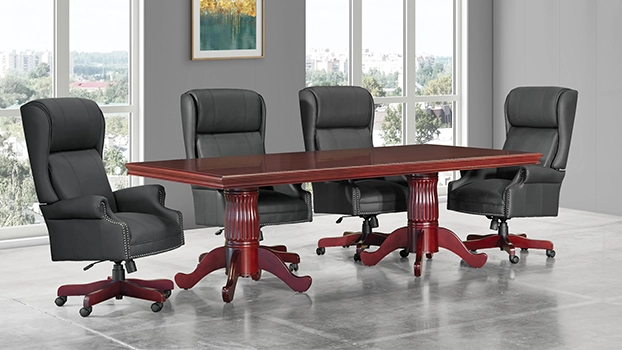
Wood Veneer Conference Table with Queen Anne Base 8ft by Office Star
View & OrderWhichever surface you choose, the room planning matters just as much as the table itself. An 8-foot table needs at least 3 feet of clear chair space on each long side, plus walking room on the ends — figure a minimum room size of about 14 by 16 feet for that configuration. Larger tables need more. A 12-foot table in a room that only gives you 18 or 19 feet of length will feel cramped, and the people seated at the ends will always feel squeezed.
Also plan for how the table will get into the room. Conference tables over 10 feet often need to be partially disassembled for delivery — check your door widths, hallway clearances, and elevator dimensions before you order. This is especially important with veneer tables, since the finish is more vulnerable during handling. If you're not sure, call us before placing the order and we'll help you think it through.
Start with the room's real purpose and usage pattern, not the finish you like in the photo. For most conference rooms in commercial offices, the laminate table is the right call — it's durable, lower maintenance, more budget-friendly, and looks professional for years. For executive boardrooms where the finish is doing credibility work, veneer is worth the investment. Shop conference tables at FindOfficeFurniture.com or call us — we've been helping businesses furnish meeting rooms for over 30 years and we're happy to help you get the spec right before you commit.
Shop Conference Tables at FindOfficeFurniture.comLaminate tops are built from high-pressure or thermally fused layers that resist scratches, heat, and stains very well under daily use. Real wood veneer has depth and warmth that laminate approximates but doesn't fully replicate, but it needs more careful handling — heavy binders, cups without coasters, and rough daily use can damage veneer in ways laminate would shrug off. For high-traffic rooms, laminate holds up better without refinishing over time.
In person, yes — the grain depth and natural variation in real veneer is noticeable up close. From across the room or in photos, the gap narrows considerably, especially with quality laminate finishes. If your boardroom needs to signal executive-level quality to clients or senior leadership, veneer makes a stronger impression. For internal team rooms and daily-use spaces, a well-chosen laminate finish works fine and most visitors won't notice the difference.
You can if you're careful about finish selection. Many manufacturers offer laminate colors that closely match popular veneer species, and when the tones align, the mix reads as intentional. The bigger challenge is sheen and texture: veneer has a depth that laminates don't fully copy. A good approach is to use one finish for the table and the other for accent pieces like credenzas, so the visual hierarchy is clear.
Laminate tables typically run 180–500 lbs depending on length and base style. Veneer tables tend to come in 220–600 lbs because of substrate and finishing materials. Both require advance planning for delivery: measure door openings, hallway widths, and elevator capacity before ordering anything over 10 feet. Veneer tables are also more sensitive to handling during installation, so experienced installers matter more.
Laminate wins on maintenance. Wipe it with a damp cloth, avoid harsh abrasives, and it holds its appearance for years. Veneer needs occasional conditioning, protection from prolonged moisture and direct sunlight, and careful handling of spills. Over a long ownership horizon, laminate requires significantly less active care — if your office doesn't have staff actively managing furniture maintenance, laminate is the lower-risk choice.