
- Menu
- Desks
- Seating
- Tables
- Customer Service
- 1.888.719.4960
Both types get the job done during a training session, but what happens before and after the session is where the difference really shows up. Here's the practical breakdown.
Quick Verdict
If your training room resets between sessions — different layouts, different programs, or the room serves other functions when training isn't happening — the flip-top nesting table is worth the extra cost. It stores in a fraction of the space and resets in minutes. If the room stays in one layout and training is the only use, the fixed table is simpler, cheaper, and equally effective during the session itself.
| Feature / Factor | Flip-Top Training Table | Fixed Training Table |
|---|---|---|
| Typical Dimensions | 48"–72" wide, 18"–24" deep, nesting bases | 48"–72" wide, 18"–24" deep, static bases |
| Approx. Weight | 65–120 lbs | 45–95 lbs |
| Best For | Organizations that need training-room furniture to store compactly between uses | Spaces that stay in one training layout most of the time |
| Primary Strength | Nests efficiently and speeds room turnover | Lower purchase cost and fewer moving parts |
| Primary Trade-Off | Costs more and includes moving hardware that requires maintenance | Harder to store efficiently; slower to reset at scale |
| Mobility | Strong — typically on casters with linking hardware and modular layouts | Best when the room is stable and doesn't need frequent reconfiguration |
| Installation | Very easy for facility teams to move and store | Straightforward and stable once positioned |
| Maintenance | Slightly more mechanical maintenance due to the flip mechanism | Very low — fewer mechanisms to manage |
| Visual Profile | Modern and mobile | Simple and dependable |
| Long-Term Value | Very high in true multi-use environments | Strong where flexibility is secondary to budget |
During a training session, both types of tables do the same job perfectly well — they give participants a surface to work on at the right height, in the right configuration, with room for laptops, notebooks, and materials. The performance gap isn't in the session itself. It's in everything around it.
A flip-top nesting table flips the top vertically, locks it in place, and rolls on casters to nest with other units. A set of 10 tables in a 60-inch width takes up only about 36 inches of floor depth when nested — the equivalent of a narrow storage closet. You can clear a room in 10 minutes, give it another purpose for the afternoon, and reset the training layout before the next morning. Fixed tables don't offer that. Moving them means picking them up, carrying them somewhere, finding a place to stack or stand them, and reversing the whole process for the next session. For rooms that change, that overhead adds up quickly.
Go with flip-top tables when the room serves more than one purpose or when training sessions happen in varying formats. Corporate training centers, HR onboarding rooms, seminar spaces, and any room that also serves as a temporary event or meeting space are strong candidates. The ability to fold everything away and reconfigure in minutes gives you operational flexibility that a fixed table simply cannot deliver. Flip-top tables also make sense when you're planning to grow — adding more tables to a nesting system is easy, and the storage footprint scales efficiently.
Look for tables with caster locks, positive-locking flip mechanisms (not friction-fit), and linking hardware if you want tables to stay in position during longer sessions. These details matter in high-use environments.
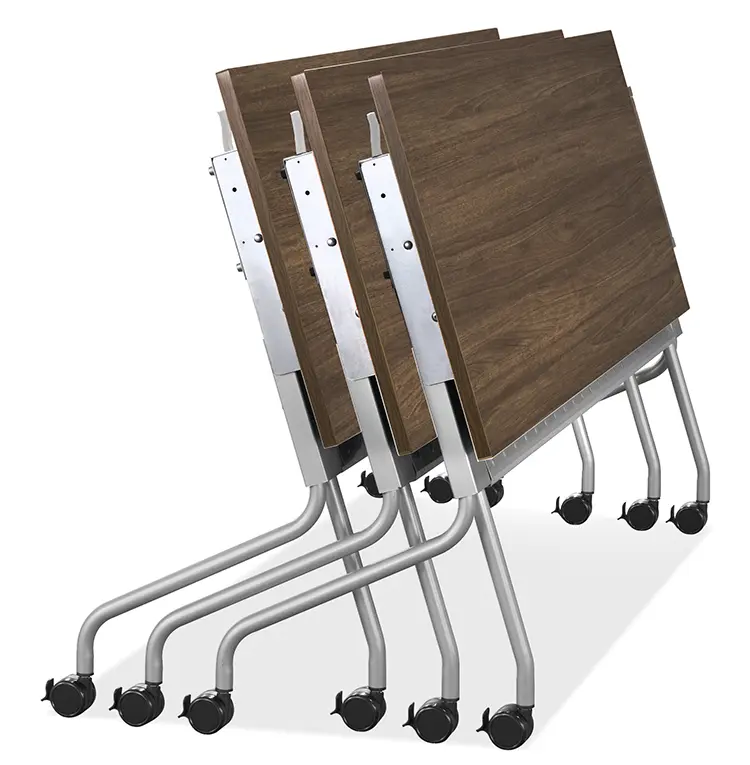
Folding Training Table 60in x 24in Flip-Top by PBD Furniture
View & OrderFixed tables earn their place in dedicated training rooms that stay in one layout. If your room runs a standard classroom arrangement Monday through Friday and nobody ever needs to move the furniture, the extra cost and mechanical complexity of flip-top tables doesn't buy you anything. Fixed tables are lighter per unit, simpler to maintain, and less expensive up front — all real advantages if flexibility isn't part of your plan.
Fixed tables are also a good choice when the room is primarily used for testing or certification environments where table stability matters and furniture movement is rare. For these applications, you want the table to feel solid and permanent, not modular and mobile. Fixed-leg tables deliver that feeling better than nesting tables do.
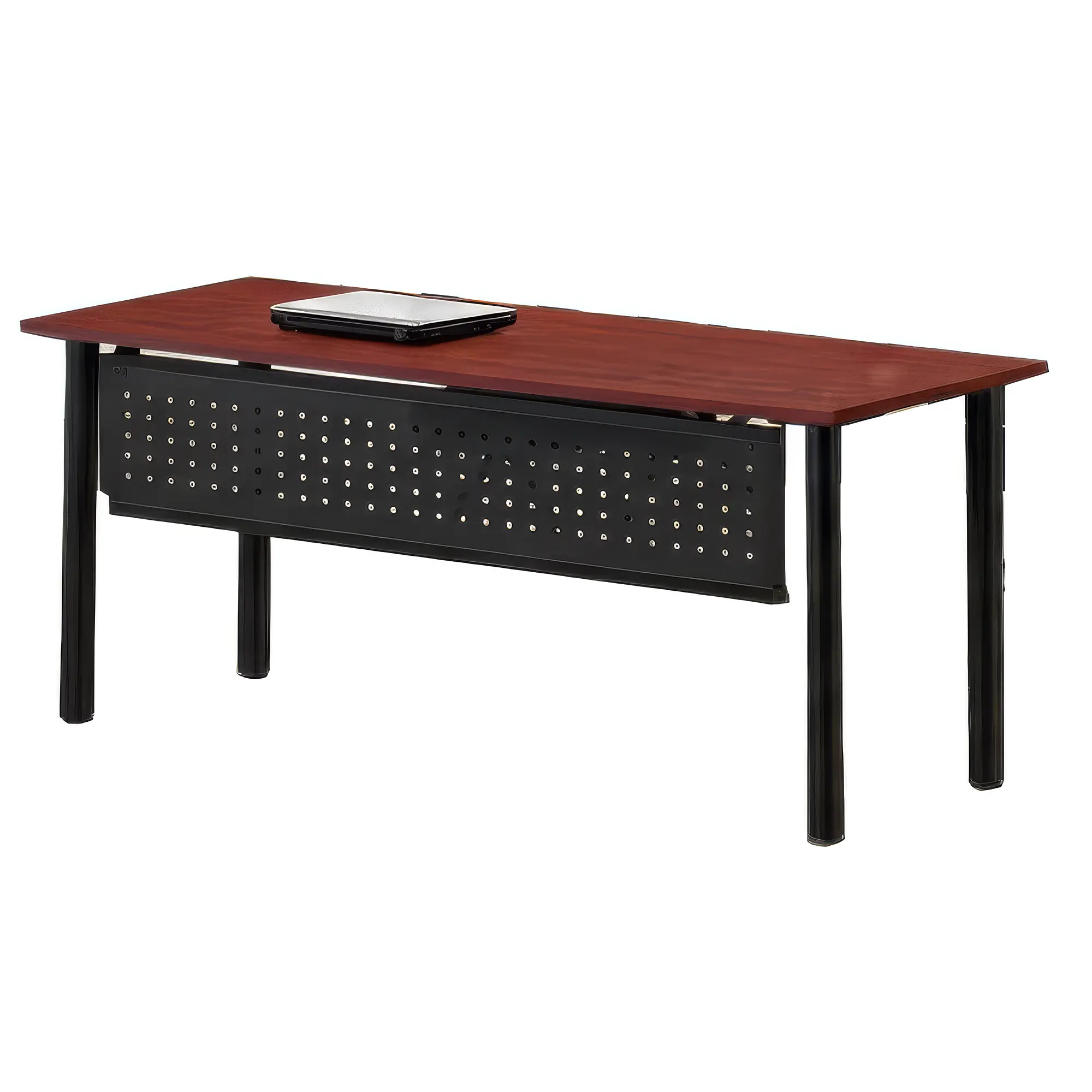
Training Table 60in x 24in with Post Legs by Office Star
View & OrderBefore you decide, think carefully about where the tables go when they're not in use. Fixed tables require real storage real estate — a closet, a back hallway, or a dedicated storage room with enough clearance to move them in and out. If that space isn't available, they tend to stay in the room permanently, which limits the room's usefulness for other purposes.
Flip-top tables nest in a column that can often stand in a corner of the room itself, behind a door, or in a modest storage area. That's a meaningful operational difference if your facility is space-constrained. Think through the full lifecycle of the furniture — deployed, stored, and reset — and match the table type to how the room actually runs.
For rooms that change, flip-top nesting tables are the smarter long-term investment — the storage efficiency and setup speed pay dividends every week. For dedicated training rooms with a fixed layout, fixed tables are perfectly capable and more cost-efficient. The right answer is the one that fits how your room actually operates. Call us if you're planning a training room from scratch — we're happy to help you work through the layout, the quantity, and the right table spec before you order.
Shop Tables at FindOfficeFurniture.comMost flip-top nesting tables can be stacked 6–10 units deep depending on the manufacturer's base design. When nested, a set of 8 sixty-inch tables takes up only about 36–40 inches of floor depth — the equivalent of a narrow storage alcove. Always confirm the nesting depth spec with the manufacturer before ordering if you have a specific storage area to work around.
Quality flip-top tables are designed to be stable in the deployed position — the locking mechanism keeps the top flat and the base locked out. That said, the locking point is a mechanical component, and if it's not fully engaged the table can be less stable than a fixed-leg table with no moving parts. For normal training use, both work well. For environments with heavy daily use or rough handling, fixed tables may hold up longer over time.
Flip-top tables typically weigh 65–120 lbs per unit because the nesting base and flip mechanism add material. Fixed training tables usually come in at 45–95 lbs for the same dimensions. The difference is noticeable when moving a full room's worth of tables, but fixed tables have no nesting benefit, so you're moving more footprint to clear or store them.
Some fixed tables offer optional caster bases at the time of order, but most are not designed for easy mobility after the fact. Flip-top tables with caster bases are a better choice if mobility is part of the brief. If you're considering fixed tables but need some movement capability, look specifically for models that offer a caster upgrade from the manufacturer rather than trying to add them later.
Both types from quality manufacturers will last 10–15 years or more in normal commercial use. The flip mechanism is the component most likely to wear first on nesting tables — look for robust steel pivot points and positive locking rather than friction-fit designs. Fixed tables have fewer moving parts and fewer things to wear out. In high-frequency environments like institutional training facilities, fixed tables may outlast flip-tops if the locking hardware sees very heavy cycles.