
- Menu
- Desks
- Seating
- Tables
- Customer Service
- 1.888.719.4960
They both hold people and look purposeful, but training tables and conference tables are built for very different jobs. Get the match wrong and the room fights you every time you use it. Here's how to get it right.
Quick Verdict
If the room needs to flex — different group sizes, different layouts, different activities across the week — go with training tables. They reconfigure quickly, store efficiently, and handle multi-use environments without friction. If the room is dedicated to one primary function (formal meetings, client presentations, leadership sessions), a conference table creates the right setup and presence. Match the table to the room's real job, not the job you wish it had.
| Feature / Factor | Training Table | Conference Table |
|---|---|---|
| Typical Dimensions | 48"–72" wide, 18"–24" deep | 8′–20′ long, broader meeting-oriented shapes |
| Approx. Weight | 50–110 lbs per table | 180–600 lbs depending on length and style |
| Best For | Multi-use learning spaces, seminars, workshops, and flexible classroom-style layouts | Dedicated meeting rooms where teams gather around one permanent focal point |
| Primary Strength | Reconfigures quickly and supports many seating arrangements | Creates a stronger boardroom presence and supports face-to-face discussion naturally |
| Primary Trade-Off | Does not create the same formal centerpiece as a conference table | Far less flexible for training, reconfiguration, or storage |
| Accessories | Often available on casters with modesty panels and ganging options | Commonly specified with power/data modules and matching room storage |
| Installation | Simple to deploy and rearrange between sessions | More fixed installation; plan room access for large sizes |
| Maintenance | Easy to maintain under frequent room turnover | Varies by finish; generally straightforward |
| Visual Profile | Functional and adaptable | Formal and centralized |
| Long-Term Value | Very high for multipurpose rooms | Excellent in dedicated conference environments |
The question isn't really about size or style — it's about what the room is expected to do from day to day. A conference table is a permanent architectural element. It sits in place, defines the room's purpose, and creates a clear focal point for the people using it. Everyone faces everyone else. There's a hierarchy implied by the setup that works beautifully for client meetings, strategy sessions, and formal presentations. The trade-off is that the room is locked into that configuration. Move the table? That's a half-day project with help.
Training tables are the opposite. Each piece is lightweight, maneuverable, and designed to connect to other pieces or fold away when the session is over. You can set a room for 20 in a classroom layout in the morning, push everything to the walls for a standing workshop after lunch, and reset it for a panel-style discussion the next day. That kind of flexibility has real operational value, especially for organizations that run varied programming through their meeting spaces.
If your space hosts training sessions, workshops, lunch-and-learns, certification classes, or any format that changes week to week, training tables are the right investment. They let you reconfigure the room to match the session format rather than forcing every program into the same layout. They're also the better choice for rooms that serve multiple departments — HR running onboarding one week, IT running a software training the next. The ability to reset quickly means less setup time, less manual labor, and a room that feels purpose-built for whatever is happening today.
Training tables also make financial sense for organizations that need to furnish multiple rooms consistently. The per-table cost is lower, they're easier to ship and handle, and if a piece gets damaged it's a straightforward replacement rather than a custom order.
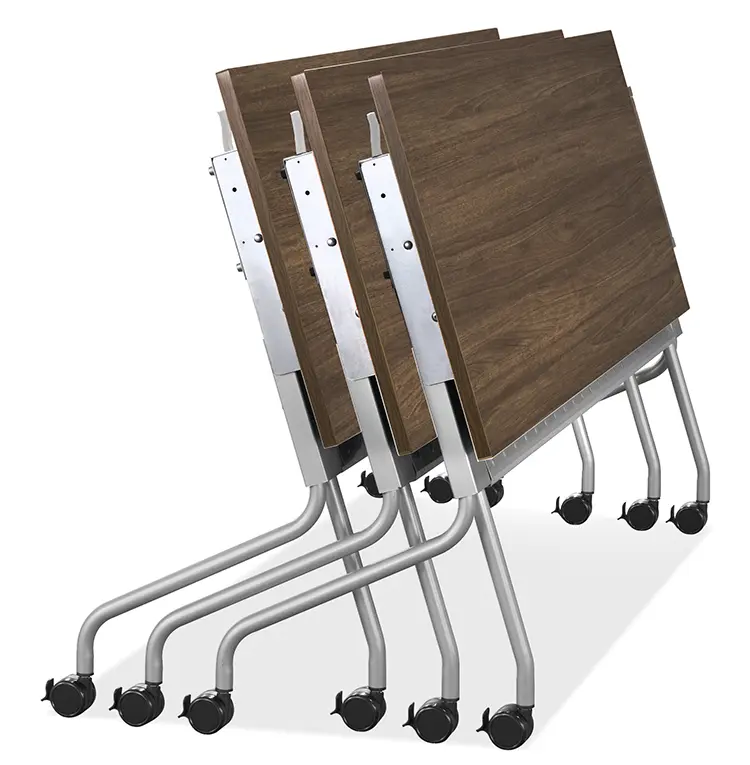
Folding Training Table 60in x 24in Flip-Top by PBD Furniture
View & OrderIf the room has one primary job — hosting meetings, client visits, and collaborative sessions around a central table — a conference table is the right furniture. The permanence is a feature, not a limitation. It anchors the room, gives it a professional presence, and creates the conditions for productive, face-to-face discussion. Conference tables also support accessories that training tables typically don't: integrated power and data modules, built-in cable management, and matching credenzas that make the room feel complete.
The right conference table also signals something about the organization. A well-chosen table in a well-planned room tells clients and partners that the company invests in its meeting spaces. That perception has value even if it's hard to quantify. If the room handles important external meetings, that investment pays off every time you use it.
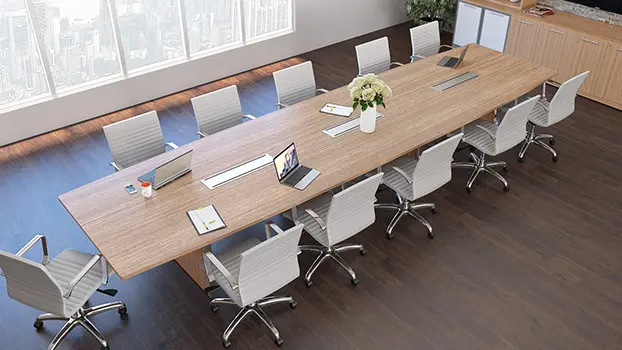
Conference Table 14ft Boat Shaped by Corp Design
View & OrderConference tables need rooms planned specifically around them. An 8-foot table requires at least 14 by 16 feet of clear floor space, and longer tables need more — you want at least 3 feet of clear space behind each chair to allow comfortable seating and movement. Check door widths and hallway clearances before ordering, especially on tables over 10 feet that may need partial disassembly for delivery.
Training tables give you much more planning flexibility. The same room that struggles to fit a 12-foot conference table might comfortably seat 16 people in a classroom layout using training tables. You can also plan around the stored configuration — flip-top tables nest together and take up a fraction of the deployed footprint, so a small storage closet off the room can hold an entire room's worth of furniture when it's not in use.
Think about the room's primary use case first. If it's a multi-purpose training and meeting room, training tables will serve you better long-term because they adapt to what you need. If it's a dedicated conference room with a consistent function, a conference table is worth every dollar. When in doubt, give us a call — we've been helping offices get the right table in the right room for over 30 years and we're happy to talk through your specific situation before you order.
Shop Tables at FindOfficeFurniture.comYes — training tables work well for regular meetings that don't need a formal boardroom setup. They can be arranged in rows, a U-shape, a hollow square, or a seminar configuration. The tradeoff is they don't create the same centered focal point or polished visual presence as a proper conference table, and they won't match high-end veneer casegoods. For internal team meetings and workshops, they're a practical and cost-effective alternative.
A typical training table weighs 50–110 lbs and can be moved by one or two people. A conference table starts around 180 lbs and can exceed 600 lbs at longer lengths. That difference matters for delivery access, room setup, and whether the table can ever be repositioned. If your room needs to change layouts regularly, training tables win on practicality by a wide margin.
An 8-foot conference table needs at least 14 by 16 feet of clear floor space — chair clearance on all sides matters. A 12-foot table needs around 18 by 22 feet. Training tables are more flexible: the same 200-square-foot room might seat 8–10 people in a classroom layout with training tables, where a conference table would feel cramped for the same group. Scale the configuration to the room and the headcount.
Some training tables include grommet holes for cable management and even integrated power strips, but the options are fewer and simpler than conference table specs. Conference tables can be ordered with built-in power modules, pop-up outlets, and hardwired data connections. If connectivity is important for your training room, look for tables with center grommets and plan the room's electrical access in advance.
Usually not. A room that needs to flex between meetings, training sessions, and other activities is exactly what training tables are designed for. You'll pay more for a conference table, lose the ability to reconfigure the room, and still need extra furniture for the training use case. The exception is a room that primarily hosts formal client or leadership meetings with only occasional secondary uses — in that case, the conference table makes sense and secondary uses adapt around it.