
- Menu
- Desks
- Seating
- Tables
- Customer Service
- 1.888.719.4960
Two very different approaches to seating a team, and choosing the wrong one creates friction that compounds every single day. Here's the honest breakdown of what each system actually delivers so you can plan with confidence.
Quick Verdict
If your team moves fast, communicates often, and you need to fit more people into less space, benching is the right call. If heads-down concentration and individual storage matter more than density, cubicles earn their footprint. Neither is a compromise — they solve different problems. Know which one your team actually has before you order.
| Feature / Factor | Benching | Cubicles |
|---|---|---|
| Typical Surface Depth | 24"–30" per seat in shared runs | Panel-enclosed stations, commonly 6’×6’ to 8’×8’ |
| Approx. System Weight | 120–300 lbs per module | 200–500 lbs per station |
| Seats per Square Foot | Higher density — more seats in less floor area | Lower density — each station occupies more room |
| Best For | Collaborative teams, hybrid workplaces, open-plan offices | Focus-intensive roles needing acoustic separation and personal storage |
| Main Advantage | Open communication, easy reconfiguration, space efficiency | Privacy, defined territory, overhead storage, acoustic control |
| Main Trade-Off | Less acoustic isolation; shared sightlines | Higher cost, larger footprint per person, slower to reconfigure |
| Storage & Accessories | Pairs well with screens, monitor arms, and mobile pedestals | Works with overhead bins, tackboards, and integrated panel storage |
| Installation | Modular — plan power and circulation carefully | Requires more labor and coordination; professional install recommended |
| Reconfiguration Speed | Fast and low-effort | Slower — involves panel teardown and power rerouting |
| Visual Feel | Open, contemporary, collaborative | Structured, semi-private, established |
| Long-Term Value | Excellent when density and collaboration drive the brief | Excellent when individual productivity and privacy improve performance |
The core difference isn't about one being modern and the other being outdated — it's about what your team's daily work actually demands. Benching is built around shared surfaces and open sightlines. There are no walls between people, which keeps communication easy and makes the floor feel energetic and collaborative. You can fit 4, 6, or 8 people into a benching run without the footprint expanding the way it would with panel systems.
Cubicles flip that calculus. Panels create real acoustic separation — not perfect, but meaningful — and give each person a defined zone for their things. Overhead storage, tackboard space, and lockable drawers are natural parts of a cubicle station in a way they aren't in benching. If your team's performance depends on extended periods of focused work, those walls do real work that an open bench can't replicate with a privacy screen alone.
Benching is the right move when your team is in constant communication, your office operates on a hybrid or hotdesk model, or you need to seat more people than your current square footage comfortably supports with panel systems. It's also the practical choice when you expect your headcount or layout to change — benching reconfigures quickly without a major installation project.
One thing to plan for: benching works best when the surrounding spec supports it. Desktop privacy screens between seats, mobile storage pedestals under or beside each position, and a monitor arm at each station make a benching run feel purposeful and organized rather than just open. Don't treat accessories as optional add-ons — they're what makes benching work at a professional level.
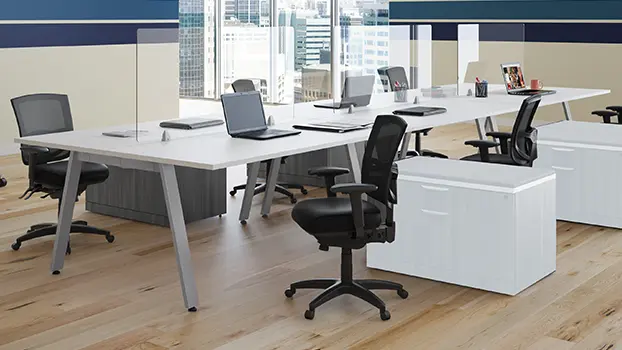
WorkStation Rectangular Bench Desk 72in x 24in by Office Star
View & OrderIf your team needs real heads-down focus — law, finance, customer service, technical writing, coding — cubicles deliver an environment that benching can't match without heavy acoustic intervention. The panels do meaningful acoustic work, the defined personal space reduces the friction of shared territories, and the storage built into the system keeps each person organized without extra furniture cluttering the aisles.
Cubicles also earn their place when the people using them will be in that station every single day for years. The investment in a proper panel system pays off as a serious long-term workspace — not a placeholder. If your employees stay and the roles are consistent, cubicles are a sound, mature specification that still does its job well.
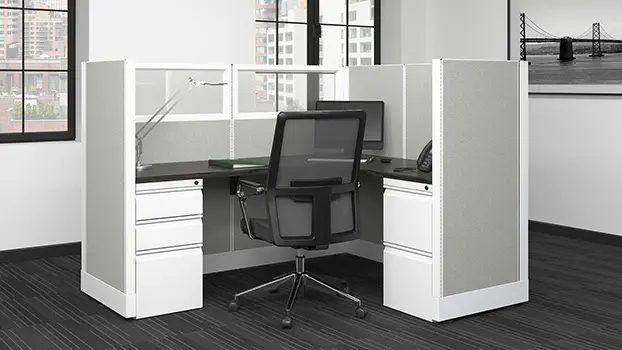
Systems Furniture 5ft Cubicle with 3 Panels by Office Star
View & OrderBenching systems typically run lower per seat than full cubicle panels, but that gap narrows once you add the accessories that make benching work at a professional level — screens, monitor arms, cable management, and mobile storage. Cubicle cost varies widely depending on panel height, fabric, and the amount of integrated storage you specify. In either case, we always recommend pricing the complete workstation, not just the main surface, before drawing a budget conclusion. Free shipping at FindOfficeFurniture.com also means the sticker price is your real cost — nothing hidden at checkout.
Before you commit to either system, walk the floor with a tape measure. Benching runs need clean, unobstructed rectangular zones — awkward columns, odd angles, and misplaced doors create real planning problems that look minor on paper. Each seat needs comfortable chair clearance behind it, plus a walking aisle that doesn't force people to squeeze past occupied chairs all day.
Cubicle planning is more rigid but also more predictable. Standard 6x6 or 8x8 configurations tile cleanly if your floor is a reasonable shape. Account for emergency egress paths, electrical access panels, and HVAC diffusers before finalizing the layout. If you have any doubts about fit, call us — we've been helping offices plan workstation layouts for over 30 years and we're happy to work through the numbers with you before you order.
For collaborative, growing teams and hybrid offices, benching is the more flexible and cost-efficient specification. For roles that demand sustained focus, personal organization, and acoustic separation, cubicles remain one of the most effective workstation investments you can make. Neither is wrong in the right context — the mistake is choosing one based on aesthetics rather than how your team actually works. Shop workstations at FindOfficeFurniture.com or give us a call and we'll match you to the right system for your team size and floor plan.
Shop Desks & Workstations at FindOfficeFurniture.comBenching gives your team more seats per square foot with an open, collaborative feel — but everyone shares the same sightlines and acoustics. Cubicles use panels to carve out semi-private zones, giving each person more defined territory and acoustic separation. The practical choice comes down to whether your team's daily work requires heads-down concentration or whether communication and movement flow are more important to performance.
Benching systems typically allocate 40–60 square feet per person when you include chair clearance and circulation paths. Cubicles require more — standard 6x6 stations need 36 square feet of footprint alone, and with aisles you're usually planning 60–80 square feet per person. If your headcount is growing and floor space is fixed, benching lets you fit more people without a remodel.
Yes — desktop privacy screens are one of the most common benching accessories, and they make a real difference without converting the setup to cubicles. You can also add acoustic panels between runs to reduce sound transfer. Benching systems are designed to be modular, so adding screens, monitor arms, or cable management after installation is straightforward and doesn't require reconfiguring the whole layout.
Cubicle reconfiguration is possible but takes real planning — it involves disassembling panels, moving power feeds, and often calling in a professional installer. Benching reconfiguration is generally faster because the modules are lighter and don't depend on panel-mounted power runs. If you expect headcount to shift significantly in the next year or two, benching gives you more flexibility without a major installation project each time.
Benching is the stronger fit for hybrid work because unassigned seats look intentional rather than empty. A benching run at 60% capacity still reads as a functional collaborative space. Cubicles at 60% capacity can feel sparse and underused, and partially occupied panels start to feel more like barriers than workspace. If hotdesking or rotation scheduling is part of your model, benching supports that workflow more naturally.