
- Menu
- Desks
- Seating
- Tables
- Customer Service
- 1.888.719.4960
Under-desk storage sounds simple, but the choice between mobile and fixed has a bigger impact on your office setup than most people expect. Here's what actually matters when you're deciding between the two.
Quick Verdict
Mobile pedestals are the more flexible, versatile choice — they add personal storage without committing to a permanent layout, work with virtually any desk type, and can be reassigned or moved if the office changes. Fixed pedestals deliver a cleaner, more integrated look and work best when the workstation is permanent and the goal is a polished, furniture-grade appearance. If you're not sure whether your office layout is final, start with mobile.
| Feature / Factor | Mobile Pedestal | Fixed Pedestal |
|---|---|---|
| Typical Size | 15"–18" wide; sized to roll under or beside standard desks | Built into the desk footprint; commonly 15"–20" wide as part of the desk structure |
| Approx. Weight | 45–90 lbs | Adds 60–120 lbs to the desk per pedestal |
| Best For | Flexible offices, benching setups, and workstations that may change over time | Dedicated private offices where the desk is expected to stay in place |
| Main Advantage | Adds personal storage without permanently committing to one layout | Creates a unified, furniture-quality desk profile with storage built in |
| Main Trade-Off | Occupies knee or floor space when pulled out; needs clear rolling clearance | Harder to reconfigure or swap out if the office layout or user changes |
| Typical Drawer Config | Box-box-file or box-file; some all-box and all-file options available | Box-box-file or double-file; configuration fixed at time of desk purchase |
| Lock Options | Central drawer lock standard on most models | Integrated into desk lock system on many executive models |
| Installation | None — unpack and roll into position | Planned and assembled with the desk; harder to modify independently |
| Compatibility | Works with almost any desk; check clearance before ordering | Specific to desk model — must match the desk it's designed for |
| Long-Term Value | High — one unit can serve multiple desk configurations over time | Best when permanence and appearance matter more than flexibility |
The core question is whether your desk setup is permanent or flexible. Fixed pedestals are built for permanence — they're part of the desk, they match the desk, and the combination looks like one cohesive piece of furniture. That's a genuine advantage in a dedicated private office where the desk won't move and the person using it isn't going to change. The integrated look is polished, the storage is always in the same place, and there's no separate piece to worry about.
Mobile pedestals are built for the real world, where offices change. Headcount grows, people relocate, benching gets reconfigured, or someone decides to switch from an L-shaped desk to a straight desk. A mobile pedestal handles all of that — it just rolls. It can serve one workstation today and a different one after the next move. That adaptability is worth a lot in any organization that's still figuring out its space, and it's essentially free — mobile pedestals don't cost more than fixed storage in most comparable configurations.
Mobile is the right default for most offices. If you're furnishing a benching environment, an open plan, a co-working space, or any desk configuration that might change, mobile pedestals solve the personal storage problem without creating layout commitment. They're also a smart add-on to desks that didn't come with built-in storage — a straight desk that's missing a pedestal can gain one easily without any modification. And in organizations that reassign workstations regularly, mobile pedestals let personal storage travel with the user rather than being tied to a seat.
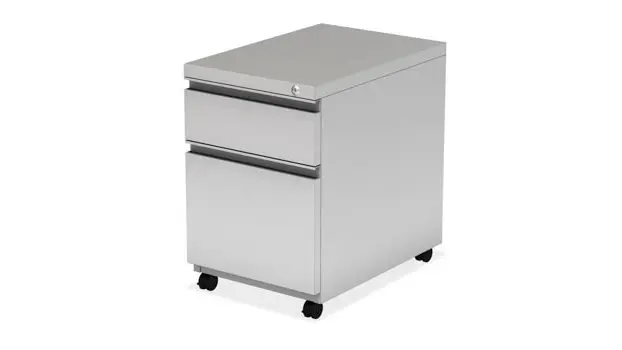
Mobile Pedestal Box-Box-File by PBD Furniture
View & OrderFixed pedestals shine in dedicated private offices and executive setups where the desk is a long-term installation and the look of the workstation matters. A double-pedestal executive desk with built-in storage looks like a serious, purpose-built piece of office furniture in a way that a desk-plus-mobile-pedestal rarely matches. If you're furnishing a C-suite office, a named individual's permanent workstation, or any situation where the visual impression of the desk is part of the professional presentation of the space, the integrated fixed pedestal is the better choice. Just plan carefully before you order — fixed configurations can't be changed after the fact.
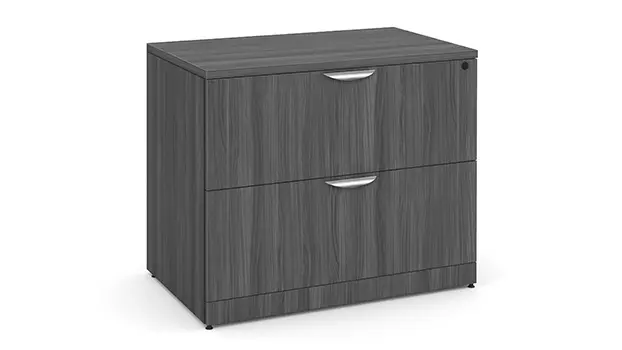
Lateral File Cabinet 2-Drawer by PBD Furniture
View & OrderIf you're adding a mobile pedestal to an existing desk, check two measurements before ordering. First, the height from the floor to the underside of the worksurface — you need at least an inch or two of clearance above the pedestal to roll it in without forcing it. Second, the open width of the knee space — the pedestal needs to fit through that opening. Most standard pedestals are 15 to 18 inches wide and 24 to 28 inches tall, but check the specs against your actual desk dimensions before committing.
Also think about whether you want the pedestal to roll under the desk for a cleaner look, or park beside it for easier access. Both work well depending on your preferences and how your chair fits in the knee space. If you're ordering a complete workstation, we can help you spec everything together so it fits properly on day one.
For most offices, mobile pedestals are the smarter, more versatile investment. They add personal storage to almost any desk, survive office reconfigurations, and give each workstation user their own lockable space without permanent commitment. Fixed pedestals are worth the upgrade when a permanent, polished private-office workstation is the goal. Find both at FindOfficeFurniture.com with free shipping. If you want help matching a pedestal to a desk or building out a complete storage plan, give us a call — we'll make sure everything fits before you order.
Shop Storage at FindOfficeFurniture.comA mobile pedestal is a freestanding storage unit on locking casters — typically housing box and file drawers — that rolls under or beside a desk and can be relocated as needed. A fixed pedestal is permanently attached to or built into the desk structure. Mobile pedestals offer flexibility and can follow users or be reassigned; fixed pedestals create a cleaner, more unified desk profile but commit the storage to that position permanently.
Most mobile pedestals are designed to fit under standard desks at 29 to 30 inches high — the typical pedestal unit is about 24 to 28 inches tall. That said, clearance varies by desk model, and knee space width also matters. Measure the open width under your desk and the height from the floor to the worksurface before ordering. If you're buying a desk and pedestal together, let us know and we'll confirm compatibility.
Generally yes. A fixed pedestal is part of the desk structure, making it inherently more stable and harder to remove physically. Mobile pedestals typically include a cylinder drawer lock that secures the contents, but the unit itself can be wheeled away if unlocked. For environments where document security is a priority, a fixed pedestal or a mobile unit anchored in place is the right choice. For most open offices, a standard mobile pedestal lock is adequate.
The most common configurations are box-box-file (two small box drawers for supplies plus a full file drawer) and box-file (one box drawer plus one file drawer). Box-box-file is the most versatile for everyday use. Some pedestals offer all-file or all-box configurations. The right choice depends on what you're actually storing daily — think through your real needs before defaulting to the most common layout.
Mobile pedestals are a natural fit for benching setups precisely because those workstation types typically don't include built-in storage. Each user gets a pedestal to pull under their section and lock when they leave. This gives individuals their own secure personal storage in a shared environment without requiring dedicated fixed-storage furniture at each seat — and without breaking the visual openness that makes benching attractive in the first place.