
- Menu
- Desks
- Seating
- Tables
- Customer Service
- 1.888.719.4960
Both solve the same basic problem — you need somewhere to put stuff. But they do it in very different ways, and picking the wrong one means either a cabinet that looks out of place or one that can't keep up with daily wear. Here's how to sort it out fast.
Quick Verdict
Steel cabinets are the workhorse pick for back offices, supply rooms, and anywhere the storage needs to take a beating. Laminate cabinets are the right call when the storage lives in a finished space and needs to look the part. Figure out where the cabinet is going and what it'll hold — that answer almost always makes the choice for you.
| Feature / Factor | Steel Cabinet | Laminate Cabinet |
|---|---|---|
| Typical Width | Commonly 36" wide, 18" deep, 72" high in full-height units | 30"–36" wide, 18"–24" deep; credenza to full-height options |
| Approx. Weight | 100–220 lbs | 120–260 lbs depending on size and top thickness |
| Best For | Back-office, supply rooms, records, and high-traffic storage areas | Private offices, reception areas, and rooms where storage should match casegoods |
| Main Advantage | Commercial durability, dent resistance, and easy-clean surfaces | Coordinates with desk and furniture collections for a polished, integrated look |
| Main Trade-Off | Looks utilitarian in finished office spaces; limited finish variety | Higher cost and less impact-resistant than steel in demanding environments |
| Finish Options | Typically gray, black, putty, or white powder coat | Matches casegoods lines — cherry, espresso, mocha, slate, and more |
| Lock Options | Strong and widely available | Available; varies by product line |
| Assembly | Many units arrive partially or fully assembled | Heavier casegoods-style assembly; plan for two people |
| Maintenance | Very low — highly resilient to everyday wear | Easy, but protect edges from moisture and heavy impact |
| Long-Term Value | Excellent when abuse resistance matters most | Strong when aesthetics carry real weight in the buying decision |
The difference between a steel cabinet and a laminate cabinet isn't about which one holds more stuff — it's about where the cabinet lives and what it needs to handle. Steel cabinets are built to a commercial standard: the shell is heavier gauge metal, the shelves are thick and reinforced, and the whole thing is designed to absorb a decade of hard daily use without showing much for it. You'll find them in server rooms, supply closets, medical offices, and back-of-house workrooms. They're not trying to be beautiful — they're trying to be dependable.
Laminate cabinets come from the casegoods world. They're built to coordinate with your desk, your bookcase, and your credenza so the whole room looks intentional rather than assembled from whatever was in stock. The finish options match furniture collections, the proportions are designed for finished spaces, and the overall look is warm and professional rather than industrial. If a client might see it, a laminate cabinet is almost always the better choice.
Steel is the right call when the storage needs to work hard in a demanding environment. Think supply rooms that get opened dozens of times a day, file areas that hold heavy binders and boxes, breakrooms that take routine abuse, or any space where the cabinet might get bumped, scuffed, or overloaded on a regular basis. Steel handles all of that without flinching. It's also the practical pick when security matters — heavy-duty locks are standard across most steel cabinet lines, and the material itself resists forced entry better than wood-composite construction.
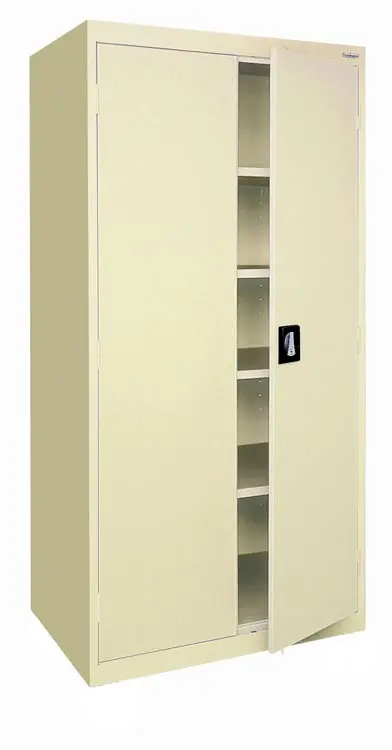
Storage Cabinet 46in x 24in D x 72in H by Sandusky Lee
View & OrderIf the cabinet is going into a private office, a conference room, a reception area, or any space where the room has a finished, coordinated look, laminate is the better choice every time. The finish options match the major furniture collections so you're not mixing visual worlds — warm wood tones with cold industrial gray never looks intentional. Laminate cabinets also tend to be built with furniture-grade hardware and better proportions for office layouts, so they feel like part of the room rather than an afterthought. The higher initial cost is real, but it buys you a piece that actually belongs in the space.
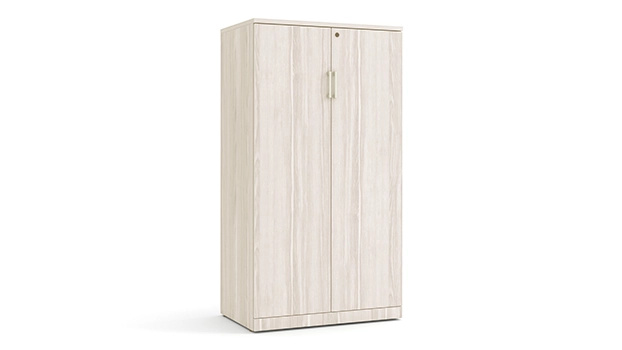
Storage Cabinet 65.5in H Laminate Wood Door by PBD Furniture
View & OrderSteel cabinets typically carry a lower entry price, but that's not the whole picture. If a steel cabinet ends up looking out of place in a client-facing area and you replace it with a laminate unit later, you've spent twice. If a budget laminate cabinet fails under heavy daily load and needs replacing in a few years, the same logic applies. The better approach is to match the product to the use case from day one, then compare full ownership cost — not just the opening number. Free shipping at FindOfficeFurniture.com means the price you see is what you pay, which makes the comparison cleaner.
Most full-height storage cabinets — steel or laminate — run 36 inches wide, 18 to 24 inches deep, and 65 to 72 inches tall. That footprint doesn't change much between materials, but what does change is the clearance you need around them. Steel cabinets in back-office areas often have other equipment, shelving, or stored goods nearby — make sure you've got enough room to open the doors fully and access the shelves without moving things. Laminate cabinets in finished offices need breathing room too: a cabinet jammed against a wall with no room to swing the door open becomes frustrating fast.
Also consider shelf adjustability. Most quality cabinets in both categories have adjustable shelves, but check before you order — fixed shelves limit what you can store over time. If you're not sure which product fits your space best, give us a call. We've been helping offices get storage right for over 30 years.
Match the cabinet to the room. Steel in workrooms, supply areas, and back-office spaces — it's tough, practical, and cost-effective. Laminate in private offices, reception areas, and any room where the storage needs to look like it belongs. Both categories have excellent products at FindOfficeFurniture.com with free shipping included. If you want help narrowing down sizes, finishes, or companion pieces, give us a call — we'll get you sorted.
Shop Storage at FindOfficeFurniture.comSteel cabinets are built for toughness — they handle heavy daily use, resist dents better than most materials, and clean up fast after spills or scuffs. Laminate cabinets are built to look good alongside your desks, credenzas, and bookcases. They carry the same finishes as your casegoods, so the storage blends into the room rather than standing out as utility furniture. If the cabinet lives in a back room or supply closet, steel is the practical pick. If it's in a private office or reception area, laminate fits the space better.
In high-traffic or heavily loaded situations, yes — steel wins on pure abuse resistance. For normal office use, a quality laminate cabinet is plenty durable and holds up well for many years. The difference shows up most in environments where drawers get slammed, shelves get overloaded, or the cabinet gets bumped around regularly. In a private office or conference room where normal care is expected, laminate durability is rarely a concern.
Laminate cabinets, by a wide margin. Laminate finish lines are specifically designed to coordinate with office furniture collections — the same cherry, espresso, slate, or mocha finish on your desk is often available on the matching storage cabinet. Steel cabinets come in a narrower range of colors and aren't designed to blend with wood-look casegoods. If matching your storage to the room matters, laminate is the clear answer.
Generally yes — steel cabinets tend to come in at a lower starting point than comparable laminate units. But the gap narrows when you factor in quality. Mid-range laminate cabinets built on furniture-grade particleboard with solid hinges and adjustable shelves are often priced close to steel equivalents of the same size. A cabinet that holds up for ten years at a slightly higher price is almost always better value than one you're replacing in five.
You can, but it takes thought. A steel cabinet in a reception or lobby area tends to read as utility furniture and can break the visual continuity of the space. If your reception area has warm wood-tone furniture, a gray steel cabinet will look out of place. That said, if your office aesthetic is industrial or modern with metal accents, a steel cabinet can absolutely work. When in doubt, call us — we've helped people find storage solutions that look right and work right for every kind of space.