
- Menu
- Desks
- Seating
- Tables
- Customer Service
- 1.888.719.4960
They both hold your files, but they work differently, take up space differently, and suit different office situations. Here's the honest breakdown so you can pick the right one without a second guess.
Quick Verdict
For offices with available wall width and multiple people accessing files, a lateral file cabinet is the smarter choice — better access, more top-surface utility, and a lower, more architectural profile. For small offices, private workspaces, or anywhere wall width is genuinely tight, a vertical cabinet packs filing capacity into the narrowest possible footprint. Both do the job well when matched to the right space.
| Feature / Factor | Lateral File Cabinet | Vertical File Cabinet |
|---|---|---|
| Typical Width | 30"–42", shallower depth than vertical | 15"–18" wide, 25"–28" deep |
| Approx. Weight | 120–250 lbs depending on drawer count and fire rating | 60–150 lbs for standard units |
| Best For | Offices that want wide drawer access and top-surface utility | Small offices that need filing capacity in a narrow footprint |
| File Access | Wide drawer opens to a full file face — scan left to right, easy multi-user access | Deep drawer projects into room — files accessed front to back |
| Top Surface | Credenza height (28–30") — useful for printer, trays, or supplemental workspace | Only 2-drawer vertical files serve as a credenza surface |
| Wall Footprint | Uses more wall width but stays shallower front to back | Uses very little wall width but projects deeper into the room when open |
| Stability | Wider base and lower center of gravity — more stable | Tall units with heavy top drawers are more tip-prone; anti-tip hardware recommended |
| Accessory Fit | Pairs well with overhead shelving, desk returns, and shared filing zones | Easy to tuck beside desks or inside small file rooms |
| Visual Profile | Broader and more architectural; fits modern open office layouts | Traditional and utilitarian; blends into private offices and file rooms |
| Long-Term Value | Strong where accessibility and shared use matter | Excellent where compact filing in a narrow width is the main priority |
The fundamental design difference between lateral and vertical file cabinets is which dimension is used to access files. A lateral cabinet opens a wide, shallow drawer that presents files horizontally — you can see and reach the entire file face at once, typically holding letter and legal files in either front-to-back or side-to-side orientation. This makes file retrieval fast and easy, especially for multiple users accessing the same cabinet throughout the day.
A vertical cabinet opens a narrow, deep drawer that holds files front to back, like a traditional file box. You access files by reaching into the drawer depth, which means front files are always easier to grab than rear files. In a private office where one person manages their own files, that's rarely a problem. In a shared space with active daily filing activity, the depth and narrow access become real friction points over time. The layout of your office and the volume of daily filing activity are usually what determine which type fits better.
Lateral file cabinets earn their place in any office where filing is a shared activity or where the cabinet's top surface can serve double duty. They're well-suited for open offices, shared administrative areas, HR departments, legal offices, and anywhere a centralized filing station makes sense. The wide drawer is genuinely easier to use when multiple people are pulling and returning files throughout the day — no one is blocking the path for anyone else, and the full file face is visible without rummaging.
The top surface benefit is practical and often overlooked. A 2-drawer lateral file cabinet at 28–30 inches tall is the perfect height to double as a printer stand, an in/out box station, or a supplemental workspace alongside a desk. Over the course of a year, that surface utility pays back the lateral's premium over a vertical cabinet in convenience and usable square footage.
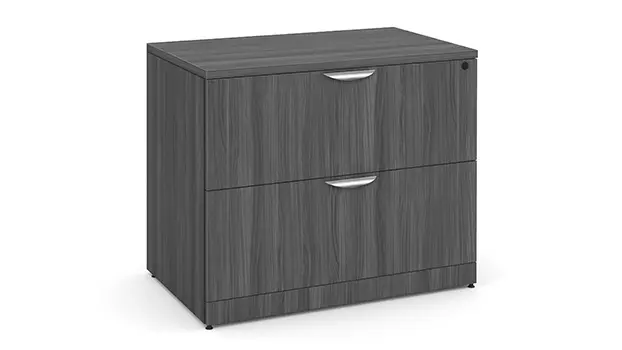
Lateral File Cabinet 2-Drawer by PBD Furniture
View & OrderIf your wall width is limited, a vertical file cabinet is often the only practical answer. At 15–18 inches wide, it's one of the most space-efficient filing solutions available — you can fit two or three vertical cabinets into the same wall width that a single lateral cabinet would occupy, and if you need the raw capacity, the vertical stack wins on space utilization. Small offices, private workspaces, home offices, and dedicated file rooms where someone is managing personal or departmental archives are natural fits.
Vertical cabinets are also simpler to spec and slightly lower in cost for comparable drawer count. For organizations furnishing a large number of private offices with basic filing needs, the vertical cabinet gets the job done without the premium. The access limitations are real but manageable in a one-person-one-cabinet situation where the user knows exactly where their files are.

4-Drawer Vertical File Cabinet by Winners Only
View & OrderMeasure carefully before ordering either type. A lateral file drawer extends 18–24 inches into the room when fully open, so you need at least that much clear space in front of it, plus comfortable standing room. A vertical file drawer can extend 20–28 inches, and you need similar clearance. In a tight office, the direction the drawer opens can actually be more important than the cabinet type itself.
For vertical cabinets — especially 4- and 5-drawer models — anti-tip anchoring is strongly recommended. A fully loaded top drawer on a tall vertical cabinet creates a significant tipping hazard when opened. Most quality cabinets include anti-tip hardware; check the spec sheet before ordering if this is a concern in your environment.
For most commercial offices and shared environments, the lateral file cabinet is the better long-term choice — easier access, more surface utility, and a profile that integrates well with modern office furniture plans. For private offices, small rooms, or situations where wall width is the limiting factor, a vertical cabinet is a capable and cost-effective solution. Shop file cabinets and storage at FindOfficeFurniture.com or call us — we've been helping businesses solve filing and storage challenges for over 30 years and we're glad to help you find the right fit.
Shop Storage at FindOfficeFurniture.comA standard 2-drawer lateral cabinet (30 inches wide) provides roughly the same linear filing capacity as a 4-drawer vertical cabinet — about 50–60 linear inches of active file space. Lateral drawers are wider and can hold files in both orientations. Lateral cabinets use wall width more efficiently; vertical cabinets use wall width more frugally. When comparing, count drawer dimensions carefully, not just the number of units.
Lateral cabinets are generally easier for multi-user access because the drawer opens wide and you scan files left to right without reaching deep. Vertical drawers project deeply and present files front to back, making rear files harder to reach. For shared filing areas used by multiple people daily, lateral cabinets are more ergonomic. For a single user with straightforward personal filing needs, vertical works fine.
A lateral file drawer typically projects 18–24 inches into the room when fully open. Vertical file drawers can project 20–28 inches. Always measure clear floor space in front of the cabinet before ordering — plan for full-open clearance plus 18–24 inches of comfortable standing room in front of the open drawer. A drawer that conflicts with other furniture becomes a daily frustration.
Yes — this is one of the most practical advantages of a lateral file cabinet. A 2-drawer lateral tops out at about 28–30 inches tall, the same height as a standard desk return, making it a natural surface for a printer, in/out trays, or supplemental workspace. Only 2-drawer vertical cabinets reach that height; taller vertical units are too high for comfortable desk-level use. If top-surface utility matters to your layout, lateral cabinets are the more useful platform.
Yes. Lateral cabinets are generally more stable because their wider base and lower center of gravity make them harder to tip. Tall 4- or 5-drawer vertical cabinets are the most tip-prone cabinet type in the office, especially with a fully loaded top drawer open. Anti-tip hardware — wall anchoring brackets or sequential drawer locks — is strongly recommended for vertical cabinets. Lateral cabinets still benefit from anchoring but are less inherently risky by design.