
- Menu
- Desks
- Seating
- Tables
- Customer Service
- 1.888.719.4960
Most offices don't need a fireproof cabinet for everything — but the ones that do really need one. This guide cuts through the confusion so you can make the right call without overspending or underprotecting.
Quick Verdict
If your files are irreplaceable originals — executed contracts, property records, compliance documents, original medical or legal files — a fireproof cabinet is a worthwhile investment. For routine business paperwork that exists in digital form or can be recreated, a standard file cabinet handles the job well at a fraction of the cost and weight. Be honest about what you're actually storing before you commit to either one.
| Feature / Factor | Fireproof Cabinet | Standard Cabinet |
|---|---|---|
| Typical Dimensions | Available in standard vertical and lateral footprints; heavier-duty construction throughout | Vertical and lateral formats with conventional office footprints |
| Approx. Weight | 300–900+ lbs depending on rating and size | 60–250 lbs depending on style and size |
| Best For | Records, legal, healthcare, and compliance-sensitive document storage | General business filing with normal access and storage expectations |
| Main Advantage | Certified protection for paper records in heat events that would destroy standard filing | Covers the vast majority of filing needs at a practical cost and weight |
| Main Trade-Off | Substantially higher cost, much greater weight, and more complex delivery logistics | No certified fire protection — records are at risk in a serious fire |
| Fire Rating | UL-rated 1-hour or 2-hour Class 350 (paper); impact and water ratings also available | No fire rating — not designed to protect contents from heat |
| Delivery Planning | Requires freight coordination; floor loading must be considered | Standard delivery; manageable with normal office planning |
| Drawer Access | Best for critical files — slower access due to heavier construction | Smooth, easy daily access for routine filing |
| Finish & Format Options | Narrower selection; typically gray or black | Broadest choice of formats, finishes, and drawer configurations |
| Long-Term Value | Excellent when the protected contents justify the premium | Exceptionally strong for routine business records and general filing |
A fireproof cabinet and a standard file cabinet both hold documents. What they don't share is any protection rating. A standard cabinet is built for daily filing convenience — smooth drawer slides, organized hanging file support, and a size and weight that works in normal office spaces. It does nothing to protect paper records from heat. In a serious fire, the contents of a standard metal cabinet will burn along with everything else in the room.
A fireproof cabinet is built around an entirely different engineering premise. The walls are thick, packed with insulating material that slows heat transfer from outside to inside. The drawers seal tightly and the overall construction is designed to keep the interior temperature below 350°F (the paper char point) for the rated duration. That protection comes with a real trade-off: these cabinets are genuinely heavy, typically three to five times the weight of a comparable standard cabinet, and that weight changes the delivery and placement conversation significantly.
The calculation is straightforward: if losing the contents would cause serious, irreversible harm to your business, protect them with a fireproof cabinet. That applies to executed original contracts that can't be reproduced, real estate deeds and title documents, regulated healthcare and medical records, compliance files required by law or auditors, and corporate records like articles of incorporation or board minutes. Industries that handle this type of documentation regularly — law, healthcare, financial services, insurance, and government contracting — often treat fireproof filing as a minimum standard rather than an upgrade. If your operation falls into any of these categories, don't cut corners on protection.
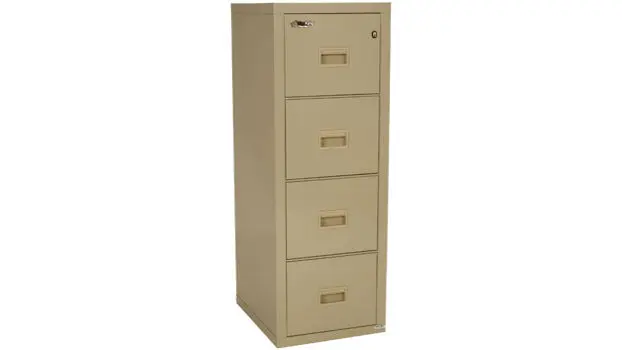
Fire Resistant File Cabinet 4-Drawer Letter Size by FireKing
View & OrderMost offices are better served by standard file cabinets for the majority of their filing needs. If the records you're storing exist in digital backups, are easily recreated from originals held by other parties, or aren't subject to compliance-driven retention requirements, there's no practical reason to pay the fireproof premium. Standard cabinets offer a much wider range of formats, finishes, and price points, and they integrate more easily into normal office spaces. They're also far more practical for active filing: the drawers move smoothly, the weight is manageable, and you can reconfigure or relocate them without major logistics planning. For most day-to-day business operations, a well-chosen standard cabinet is the right answer.
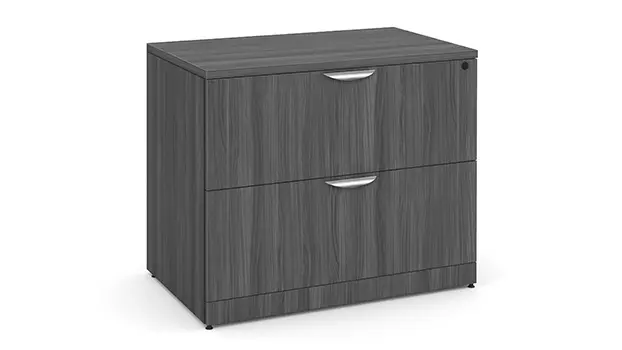
Lateral File Cabinet 2-Drawer by PBD Furniture
View & OrderThe price gap between fireproof and standard cabinets is real and significant — not a rounding error. Standard lateral and vertical file cabinets cover a broad range at accessible prices. Fireproof units carry a substantial premium that reflects the engineered insulation, heavier-gauge construction, and certified testing involved in producing a rated product. That premium is completely justified when the documents inside are irreplaceable. It's unnecessary overhead when they're not. The best approach is to be deliberate: keep your critical documents in a rated fireproof cabinet and handle everything else with standard filing. That way you're not paying the fireproof premium on ten drawers' worth of routine correspondence.
Before ordering a fireproof cabinet, work through the logistics. A 4-drawer fireproof vertical cabinet can weigh 700 to 900 lbs — that weight doesn't go up stairs easily, and it may exceed safe floor loading for some commercial building configurations. Make sure your freight elevator can handle it, confirm the floor loading capacity if there's any doubt, and plan exactly where the cabinet will live before delivery day. Once a unit like this is in place and loaded, moving it is a project in itself. Standard cabinets have no such complications and can typically be placed by two people with a hand truck.
Also consider door swing clearance for both types — a full-extension drawer needs enough clear floor depth in front of it to open completely and allow practical access. Don't forget that clearance when measuring the space.
Protect what's genuinely irreplaceable with a fireproof cabinet — and only that. Use standard filing for everything else. That combination gives you certified protection where it counts and practical, cost-effective storage for your everyday records. FindOfficeFurniture.com carries filing options across both categories with free shipping included. Call us if you need help thinking through which documents qualify for fireproof protection or which standard filing format fits your workflow best — we're happy to talk it through.
Shop Storage at FindOfficeFurniture.comFireproof cabinet ratings — typically issued by UL (Underwriters Laboratories) — indicate how long the cabinet can protect paper records from internal temperatures exceeding 350°F during an external fire. The most common ratings are 1-hour and 2-hour. Ratings are tested separately for Class 350 (paper), Class 125 (photos and magnetic media), and impact resistance after water dousing. Always verify what the product is rated for before assuming comprehensive coverage.
Significantly heavier. A standard 2-drawer lateral file cabinet might weigh 100 to 150 lbs. A comparable 2-drawer fireproof lateral can weigh 300 to 500 lbs, and larger 4-drawer vertical fireproof units can exceed 800 lbs. This weight requires special freight arrangements, and the floor must be able to handle the load. Repositioning the cabinet later is a serious operation that requires planning.
Not automatically. Some fire-rated cabinets carry an additional water-resistance or impact rating, meaning they're tested to survive being knocked from a height and subsequent water dousing from fire suppression. If the cabinet will be in a building with a sprinkler system, the water-resistance rating is worth checking — files that survive the fire can still be destroyed by water infiltration afterward.
For the majority of everyday business records — routine correspondence, invoices, personnel files, vendor contracts — a standard file cabinet is perfectly adequate, especially when digital backups exist. Fireproof cabinets are best justified for irreplaceable originals: executed legal agreements, property deeds, medical records, and compliance documentation required by law. Ask yourself: if these files burned tonight, what would the actual business impact be? That answer usually clarifies whether the fireproof investment makes sense.
Yes, and this is actually how most offices handle it. Designate one fireproof cabinet specifically for documents that genuinely need protection and handle everything else with standard filing. This keeps the cost and weight investment focused where it matters and keeps the rest of your filing operation practical. Just ensure the fireproof cabinet is positioned where its weight won't create a floor loading problem and where it's accessible without moving other furniture.