
- Menu
- Desks
- Seating
- Tables
- Customer Service
- 1.888.719.4960
Two desks that look similar in a catalog photo but feel very different once they're in your office. Here's the honest breakdown so you can pick the right one and not regret it six months later.
Quick Verdict
If you need real, usable workspace for daily multi-tasking, the L-shaped desk is the smarter buy — more surface, better accessory support, and a stronger long-term value. The corner desk wins when space is genuinely tight and you don't need to spread out much. Pick the one that matches your actual workflow, not just what looks good on the page.
| Feature / Factor | L-Shaped Desk | Corner Desk |
|---|---|---|
| Typical Width | 60"–72" main run + 42"–48" return | 48"–60" per side with a compact corner section |
| Approx. Weight | 140–240 lbs depending on storage | 90–170 lbs depending on materials |
| Best For | Two active work zones — screen + paperwork/reference | Tight rooms that need a capable desk without eating the floor plan |
| Main Advantage | Generous surface area without stepping up to a full executive suite | Fits corners efficiently and keeps the room feeling open |
| Main Trade-Off | Needs more wall length and a bit more planning at delivery | Less flat, rectangular workspace for spreading out projects |
| Storage & Accessories | Plays well with pedestals, hutches, monitor arms, and grommets | Best kept simple — light shelving or a small pedestal underneath |
| Assembly / Moving | Multi-component; plan before delivery day | Fewer pieces and easier to reposition if the layout changes |
| Minimum Room Size | 8’ × 8’ clear working area | 7’ × 7’ to 8’ × 8’ |
| Visual Feel | Substantial and professional without being stuffy | Neat and compact — works great in home offices |
| Long-Term Value | Strong for private offices and serious home offices | Smart value when square footage is the real constraint |
The core difference isn't style — it's how much usable surface you get and how that surface holds up once you've loaded it with a monitor, keyboard, documents, and your daily kit. An L-shaped desk gives you a primary run plus a full-length return, so those two zones can each do their own job without crowding each other. You can keep your computer setup on one side and paperwork, a second monitor, or a phone setup on the other. That separation makes a real difference if you're switching between tasks all day.
A corner desk also uses the corner of your room, but it's designed more for containment than expansion. The total work surface is smaller, the depth is typically shallower, and it doesn't have the same built-in zones. That's fine — and even ideal — when your room is compact or when your workflow is straightforward. But if you're trying to do everything from a single piece of furniture, a corner desk can start to feel cramped faster than you'd expect.
Choose the L-shaped desk when you're actually going to use both zones. That means you work from a desktop or multi-monitor setup, you handle paper-based tasks alongside digital ones, or you just need room to breathe without constantly shuffling things around. It's also the right call if you're planning to add a hutch, a pedestal, or a monitor arm — these desks are built to take accessories without feeling awkward. The investment is higher upfront, but you're not buying a bigger desk again in two years because the original one didn't cut it.
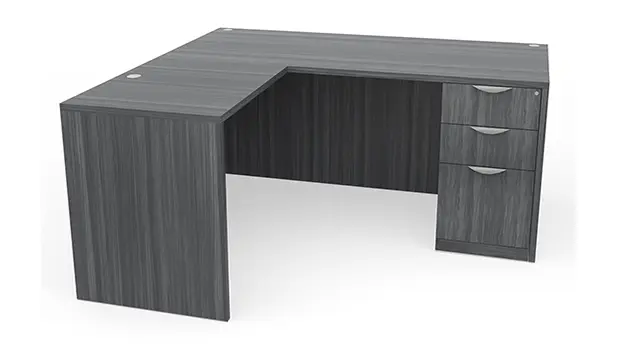
L-Shaped Desk 66in W x 66in D with Hutch by PBD Furniture
View & OrderThe corner desk is absolutely the right pick for smaller offices, spare bedrooms turned workspaces, or any situation where keeping the room feeling open matters more than maximizing your desk real estate. It's also easier to move — fewer components, lighter weight, and simpler to reconfigure if your setup changes. Don't write it off as a compromise; in the right room with the right workflow, a corner desk is the more practical and purposeful choice. It solves the actual problem without the overhead of a bigger piece that would overwhelm the space.
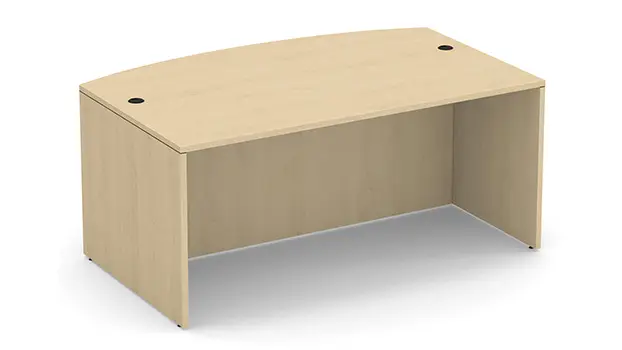
Bow Front Desk 66in W x 30in D by PBD Furniture
View & OrderL-shaped desks run higher than corner desks — that's just reality. But before you default to the cheaper option, think through the full picture. If a corner desk leaves you short on workspace and you end up adding a separate table, a storage cart, or replacing it altogether within a couple of years, you've spent more than if you'd bought the L-desk to begin with. We always recommend pricing the complete workstation — desk, storage, accessories — not just the main piece. That's how you find the real value. Free shipping at FindOfficeFurniture.com also means the sticker price is what you pay.
Before you order either one, pull out a tape measure. An L-shaped desk needs at least 8 feet by 8 feet of open working area to feel comfortable — that's the desk footprint plus enough room to push your chair back, open a file drawer, and walk around without squeezing. Corner desks can fit into tighter spaces, sometimes as small as 7 by 7 feet, but the real question is how that remaining floor space will feel once the desk is in it.
Check your door swing, your window access, and how other furniture will interact with the desk. A desk that fits on paper but creates awkward traffic patterns isn't actually a good fit. If you're not sure, call us — we've been helping people plan office spaces for over 30 years and we're happy to talk it through.
For most offices and dedicated home workspaces, the L-shaped desk is the better long-term investment — it gives you real workspace, plays well with accessories, and doesn't leave you wishing you had more room six months in. That said, if your space is genuinely on the smaller side or your workflow is simple and focused, the corner desk is an excellent choice that won't let you down. Shop desks at FindOfficeFurniture.com or give us a call — we'll help you find the exact size, finish, and configuration that fits your room.
Shop Desks at FindOfficeFurniture.comAn L-shaped desk gives you two full work zones — a long primary surface (typically 60–72 inches) plus a substantial return wing — so you can spread out a monitor, paperwork, and accessories without things competing for space. A corner desk is more compact, built mainly to tuck into a corner without taking over the room. If you need active space for multiple tasks at once, the L-shaped desk wins. If keeping the room open matters more, go with the corner desk.
You'll want at least 8 feet by 8 feet of clear working area for an L-shaped desk to breathe — that accounts for the desk itself, comfortable chair clearance, and a walking path. Corner desks are more flexible and can fit in rooms closer to 7 by 7 feet. Measure carefully and don't forget door swings and existing furniture clearances.
Corner desks work best with minimal storage add-ons — light shelving or a small mobile pedestal is fine, but they're not built for stacked hutches or full double pedestals. L-shaped desks are designed with accessories in mind and pair naturally with pedestals, hutches, cable grommets, and monitor arms. If storage compatibility matters, the L-shaped desk is the better platform.
Corner desks come in fewer pieces and typically weigh between 90 and 170 lbs, making them easier to assemble and reposition. L-shaped desks arrive in multiple components, weigh 140 to 240 lbs on average, and need more planning before delivery day. Corner desks are the more flexible option if you move furniture around often.
If your daily workflow needs two active zones, the L-shaped desk earns its price by keeping you organized and productive long-term. If you mostly work from a single laptop or rarely spread out, the corner desk is a capable right-sized workstation. The best value is whichever desk matches your real workflow — not the one that looks bigger on a spec sheet.