
- Menu
- Desks
- Seating
- Tables
- Customer Service
- 1.888.719.4960
More than any other desk comparison, this one comes down to role and room. Here's how to decide which one actually fits your situation — without overspending or underselling yourself.
Quick Verdict
The standard desk is the smarter buy for most offices — excellent value, flexible placement, and fully capable for the majority of professional roles. The executive desk earns its price when your office regularly hosts visitors, your role requires a commanding presence, and your room has the space to carry it properly. Don't buy an executive desk to impress yourself. Buy it when the room and the role actually call for it.
| Feature / Factor | Executive Desk | Standard Desk |
|---|---|---|
| Typical Width | 66"–84" wide with deeper top surfaces | 48"–72" wide, 24"–30" deep |
| Approx. Weight | 180–320 lbs in full commercial builds | 70–160 lbs |
| Best For | Leadership offices that need presence, visitor readiness, and image | Day-to-day workstation use where function and budget lead the decision |
| Main Advantage | Scale, finish, and authority that simpler desks can't match | Covers the essentials cleanly without forcing premium size or cost |
| Main Trade-Off | Needs more room and more budget than many offices actually need | Doesn't carry the visual weight or integrated feel of executive casegoods |
| Storage & Accessories | Pairs well with credenzas, hutches, and guest seating | Easy to pair with mobile storage and task seating across office types |
| Installation | Room-planning purchase — not something you set up on a whim | Relatively easy to deliver, assemble, and replace |
| Room Feel | Becomes the dominant visual element in the room | Keeps more of the room available for storage and movement |
| Space Requirements | Feels best in private offices with breathing room on all sides | Friendly to smaller private offices and shared workrooms |
| Long-Term Value | High when presentation and scale genuinely matter to the role | One of the safest purchasing decisions for broad office use |
An executive desk and a standard desk both give you a flat surface to work from — but that's where the overlap ends. An executive desk is a room-shaping piece of furniture. Its extra width (often 72–84 inches), greater depth (30–36 inches), and substantial construction change how the room feels. Visitors sitting across from you aren't sitting across a desk — they're sitting across a statement. The desk creates a context: this is where important decisions get made, and the person behind it has earned the right to be here. When that context matters to your professional situation, the executive desk delivers something a standard desk simply can't replicate.
A standard desk doesn't try to be a statement — it tries to be efficient. It's the right tool for focused work, it fits in more spaces, it ships in lighter boxes, and it won't require a significant portion of your furniture budget to replace if the office changes. For many professionals, including senior managers and directors who work primarily in heads-down mode, a well-chosen standard desk does the job better than an executive desk would, because it keeps the room open and the workflow clean.
The executive desk is the right call when you're in a role where the office itself communicates something — to clients, to leadership, to your team. Partners in professional service firms, C-suite and VP-level executives, owners of client-facing businesses, and senior leaders in larger organizations are all situations where an executive desk pays off in ways that go beyond the desk's functional capabilities. It's also worth the investment if you plan to stay in the same office for a long time, since amortizing the higher cost over five to ten years makes the daily value considerably stronger.
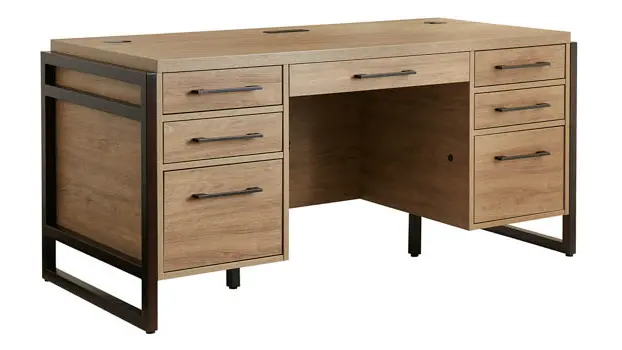
Writing Desk 60in W x 30in D by Martin Furniture
View & OrderChoose the standard desk when your work is primarily digital, your office is modestly sized, or your role doesn't regularly involve clients or leadership visitors sitting across from you. A solid 60–66 inch standard desk with a good matching pedestal and a quality chair is a genuinely professional setup — one that functions well and looks intentional without the overhead of a full executive suite. Standard desks are also the right call for companies furnishing multiple offices consistently, where managing costs across a fleet of workstations matters more than making one office look spectacular.
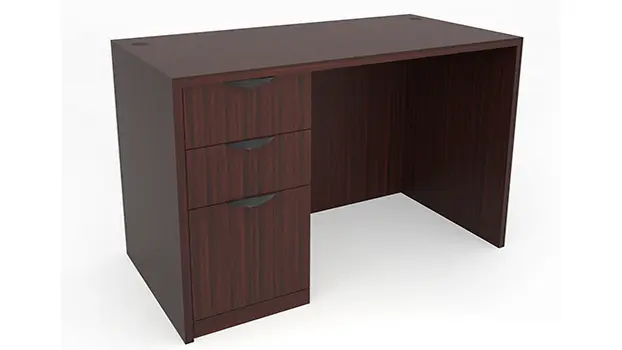
Computer Desk 48in W x 24in D by PBD Furniture
View & OrderThe price gap between executive and standard desks is real and meaningful. Executive desks — especially when paired with a matching credenza and hutch — represent a serious investment. But thinking about cost in terms of just the desk misses the full picture. If a standard desk in a leadership office doesn't communicate the right presence and you end up replacing it within two years, you've spent more overall than if you'd invested in the executive desk from the start. On the other hand, buying an executive suite for a private office that mostly operates as a solo workspace is overbuying, plain and simple. Our best advice: match the investment to the role and the room, and you'll be happy with either choice.
Executive desks are substantial pieces — 66 to 84 inches wide, 30 to 36 inches deep, and often 180 pounds or more. They need a private office that can give them breathing room on all sides: 36 inches of chair clearance behind, enough front space for two visitor chairs, and clearance for any matching storage pieces. Don't squeeze an executive desk into a small office hoping it'll fit — it won't look right, and you'll lose the functionality of the storage drawers and return wings.
Standard desks are much more forgiving. A 48–60 inch standard desk can work in rooms that feel tight for an executive piece, and pairing it with a wall-mounted bookcase or a nearby lateral file keeps the footprint contained while still giving you useful storage. If the room you're furnishing is on the compact side, the standard desk will almost always produce a better-looking, more functional result than forcing a large executive desk into the space.
For most professionals and most offices, the standard desk delivers outstanding value — it's capable, adaptable, and doesn't ask your room or your budget to carry more than it needs to. Step up to the executive desk when your role, your clients, and your room all support the investment. FindOfficeFurniture.com carries both, with free shipping included and a Lowest Price Guarantee. Give us a call and we'll help you match the right size, finish, and companion pieces to your space.
Shop Desks at FindOfficeFurniture.comExecutive desks are typically wider (66–84 inches versus 48–72 inches for standard desks), deeper, heavier, and finished with more substantial materials and detailing. They often include built-in pedestals on both sides, a deeper work surface, and optional returns or credenzas that create an integrated office suite. The result is a desk that serves as the dominant visual element in the room, projecting authority and accommodating visitor seating comfortably.
It depends on your role and how the office is used. If clients or leadership colleagues regularly sit across from you for meetings, the executive desk's presence is genuinely valuable. If the office is primarily heads-down work and visitors are occasional, a standard desk with good storage often performs just as well. Ask yourself how often other people sit across your desk — not just how impressive you want the room to look.
Executive desks typically need a private office of at least 10 by 12 feet for the desk alone, with 12 by 14 or larger being ideal for a full suite including a credenza. You need 36 inches of chair clearance behind the desk, comfortable approach space for visitors in front, and side clearance for file drawers. Don't force a large executive desk into a room that can't support it — the result won't look right and you'll lose functionality.
Absolutely. A well-chosen standard desk in the 60–72 inch range, paired with a matching credenza or storage cabinet and a quality chair, can look polished and professional. The key is matching the finish and style across pieces and keeping the room organized. A clean, coordinated standard setup often looks more intentional than an oversized executive desk crammed into a room that can't accommodate it.
Executive desks pair naturally with matching credenzas, hutches with glass doors, lateral file cabinets, and guest seating grouped in front of the desk. Standard desks work well with mobile pedestals, a single lateral file, and bookcase storage on nearby walls. The executive suite approach creates an integrated furniture-grade room; the standard desk approach gives you more flexibility to mix and adapt pieces as needs change.