
- Menu
- Desks
- Seating
- Tables
- Customer Service
- 1.888.719.4960
This is one of the most common desk decisions we help buyers work through. Here's the honest comparison — no fluff, just what you need to know to get the right desk for your room and your work style.
Quick Verdict
The straight desk is the smarter buy for most people — it's easier to place, easier on the budget, and genuinely capable for focused single-zone work. Step up to the L-shaped desk when your workflow consistently needs two active work areas and your room can handle the extra footprint. Don't buy more desk than you actually need.
| Feature / Factor | Straight Desk | L-Shaped Desk |
|---|---|---|
| Typical Dimensions | 48"–72" wide, 24"–30" deep | 60"–72" main run + 42"–48" return |
| Approx. Weight | 70–160 lbs based on width and storage | 140–240 lbs depending on storage and laminate |
| Best For | Focused single-zone work — clean, efficient, value-driven | Two-zone workflows: computer work plus paperwork or reference |
| Main Advantage | Easy to place, budget-friendly, pairs well with mobile storage | Generous surface area without stepping up to a full executive suite |
| Main Trade-Off | Doesn't create separate work zones on its own | Needs more wall length and more planning before delivery |
| Storage & Accessories | Works with pedestals, returns, hutches, and monitor arms easily | Designed for full accessories including hutches, pedestals, grommets |
| Room Requirements | Comfortable in rooms from about 6’ × 8’ | Best with at least 8’ × 8’ of clear working area |
| Assembly & Relocation | Straightforward — simpler to move during office changes | Multi-component; plan carefully before delivery day |
| Visual Profile | Clean, efficient, and adaptable | Substantial and professional without feeling overly formal |
| Long-Term Value | One of the strongest values in office furniture overall | Strong for private offices and productive home setups |
A straight desk and an L-shaped desk can look like different sizes of the same thing, but they really serve different workflows. A straight desk puts everything in front of you on a single surface — your monitor, keyboard, and daily tools all share the same run of laminate. That's actually a great setup for a lot of people: no turning, no zone confusion, just a clean working surface. When you add a mobile pedestal for files and a monitor arm to free up space, a good 60–66 inch straight desk handles nearly anything a private office or home workspace throws at it.
The L-shaped desk earns its extra footprint when you genuinely need to keep two separate working areas active at the same time — not switch between them occasionally, but actively use both. The classic use case is a computer setup on the main run and a paperwork or reference zone on the return. If that describes your actual workday, the L-desk will make you more productive. If it doesn't, you'll end up with a return wing that collects things you haven't dealt with yet.
Go with the straight desk when your work is primarily screen-based and you don't need to reference physical documents alongside your computer regularly. It's also the right call when you want flexibility — straight desks are easier to move, easier to pair with any storage or accessory, and far less committal in terms of room layout. Shared offices, open floor plans, and rooms that might change function in the next few years are all situations where a straight desk makes more sense than locking the room around an L-configuration. And if budget is a real consideration, a quality straight desk gives you more furniture per dollar than almost anything else in the catalog.
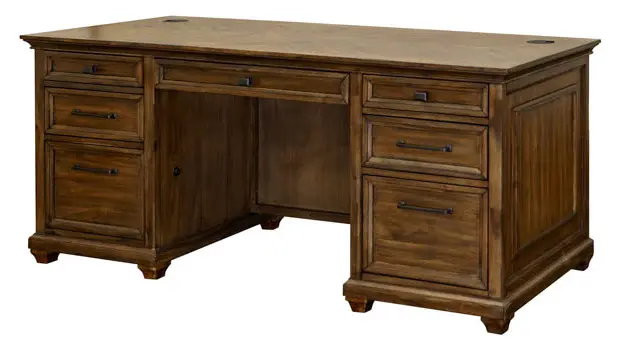
Straight Desk 60in W x 30in D by Martin Furniture
View & OrderThe L-shaped desk pays off when you're regularly splitting your time between digital and physical work — or when you need a dedicated space for a second screen, a phone station, or reference materials that need to stay accessible without crowding your primary workspace. It's also a natural choice when the surrounding furniture plan includes a hutch, double pedestals, or cable management, since L-desks are designed to integrate with these accessories cleanly. If you've had a straight desk and constantly felt like you were running out of room, the L-desk is very likely the solution.
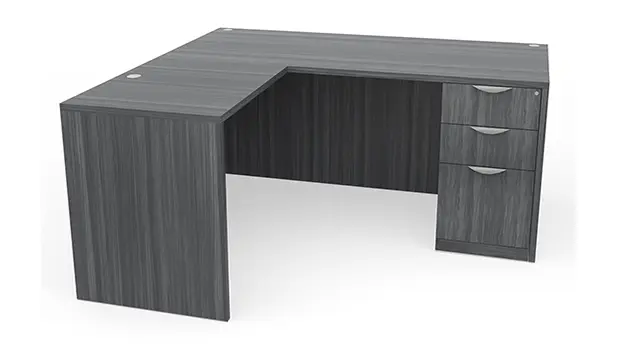
L-Shaped Desk 66in W x 66in D with Hutch by PBD Furniture
View & OrderStraight desks generally start lower than L-shaped desks — but before you treat that as a clear winner, price out the full setup. A straight desk that needs a separate credenza or a rolling cart to handle overflow can end up costing more than an L-desk that handles everything in one piece. The better question is: what does the whole workstation cost, including storage, accessories, and shipping? At FindOfficeFurniture.com, shipping is free on everything, so you're already ahead on that front. If you want help doing the full comparison, just call us — we do this every day.
Straight desks are forgiving on room size — they can work comfortably in spaces starting around 6 by 8 feet when positioned well. L-shaped desks ask for more commitment: at least 8 by 8 feet of clear working area, with attention to where the return wing will land relative to doors, windows, and traffic paths. Measure twice before ordering, and think about how your chair needs to move — not just where the desk sits when you're standing in the doorway looking at it. A desk that blocks your file drawer or your window isn't a good fit regardless of its other merits.
For most buyers, the straight desk is the right starting point — strong value, flexible placement, and genuinely capable for a wide range of office roles. When your workflow demands two active zones and your room can support it, step up to the L-shaped desk with confidence. Both are solid purchases at FindOfficeFurniture.com, with free shipping and our Lowest Price Guarantee. Give us a call if you want help narrowing it down — we're happy to talk through room dimensions, finishes, and matching pieces.
Shop Desks at FindOfficeFurniture.comStraight desks are easier to place in a room, simpler to assemble, more budget-friendly, and easier to move when office layouts change. They work well in smaller rooms (comfortable starting around 6 by 8 feet), pair easily with mobile storage and monitor arms, and are a strong choice when the primary need is a focused single-zone workstation.
An L-shaped desk makes sense when you genuinely need two active work zones — a computer setup on one side and paperwork, a secondary monitor, or reference materials on the other. It's also the better choice when you want to add a hutch, double pedestals, or integrated cable management. If your workflow involves switching between tasks that need dedicated surface space, the L-desk pays off daily.
A straight desk works comfortably in rooms starting around 6 by 8 feet. An L-shaped desk needs at least 8 by 8 feet of clear working area — accounting for the main surface, the return wing, chair clearance, and a walking path. Don't assume a room that fits a straight desk will automatically work for an L-desk without measuring first.
Both desk types accept monitor arms, hutches, and mobile pedestals, but straight desks have a simplicity advantage — they pair naturally with almost any add-on without requiring matched configurations. L-shaped desks offer more accessory real estate overall, but accessories need to work with both the main run and the return, which requires a bit more upfront planning.
A quality straight desk is absolutely a long-term purchase. Some of the most productive offices we've seen are built around a solid straight desk with smart storage alongside it. That said, buyers whose workflows grow to require separate task zones sometimes upgrade to an L-desk. Buy the straight desk if it fits your actual workflow — don't overbuy just because the L-desk looks more impressive in a photo.