
- Menu
- Desks
- Seating
- Tables
- Customer Service
- 1.888.719.4960
Both options let you alternate between sitting and standing at work — but they're very different in how they do it, how much they cost, and who they're actually right for. Here's the straight story.
Quick Verdict
If you're committed to a sit-stand workflow and you want the full desk experience at every height, the electric sit-stand desk is the better long-term buy. The desk converter is the smarter move if you want to test the concept first, you're in a leased space, or budget is the primary constraint. Don't pay for a full sit-stand desk if you're not sure you'll use it — but don't shortchange yourself with a converter if you know you'll use it daily.
| Feature / Factor | Sit-Stand Desk | Desk Converter |
|---|---|---|
| Work Surface at Height | Full desktop — 48"–72" wide, all available at every height | Smaller raised platform — usually 28"–40" wide |
| Approx. Weight | 90–180 lbs (frame + top together) | 25–60 lbs |
| Best For | Daily sit-stand users who want full desk function at every position | Users testing standing work or needing a lower-commitment upgrade |
| Main Advantage | Full ergonomic experience — no surface compromise at any height | Much lower cost; installs on existing desk in minutes |
| Main Trade-Off | Higher cost; electric models need power access | Reduces usable surface area; can feel crowded with multiple devices |
| Monitor & Accessory Fit | Works with monitor arms, CPU holders, anti-fatigue mats | Best for single monitor or laptop — wide rigs feel cramped |
| Installation | Needs careful leveling and cable planning for smooth operation | Quick to deploy — great for leased spaces or temporary setups |
| Visual Appearance | Purpose-built, furniture-grade look | Functional add-on — doesn't match most desk aesthetics well |
| Space Required | Same as a standard desk plus clear standing zone behind chair | Uses existing desk footprint but eats into working depth |
| Long-Term Value | Excellent when you'll actually use the adjustability daily | Good for testing the workflow; less ideal as a permanent solution |
The biggest practical difference isn't just price — it's what your workspace looks like while you're standing. With a sit-stand desk, your entire desktop goes up and comes down together. Every inch of your work surface is accessible at every height. Your monitor arm, your keyboard tray, your cables — they all move with the desk. It's a seamless experience that genuinely changes how you work.
A desk converter works differently: you're lifting a platform on top of your existing desk, not the desk itself. That platform is typically 28 to 40 inches wide — enough for one monitor and a keyboard, maybe two monitors if they're small. Everything else on your desk stays down at seated height. So while you're standing, you're reaching down to grab a pen, your coffee, your phone, or anything that isn't on the converter platform. For light laptop use or a focused single-screen setup, that's workable. For anyone who uses their full desk while working, it's a real limitation.
The sit-stand desk pays off when you'll genuinely use it every day. If you plan to alternate between sitting and standing multiple times throughout the workday — which is how ergonomic researchers recommend using them — then a quality electric sit-stand desk from Bush Furniture or a similar brand will serve you well for years. The electric motor makes it effortless to transition, height memory presets let you get to your exact position with one button, and the full desktop keeps your entire workflow intact whether you're up or down. Add an anti-fatigue mat and a monitor arm and you've got a proper ergonomic setup.
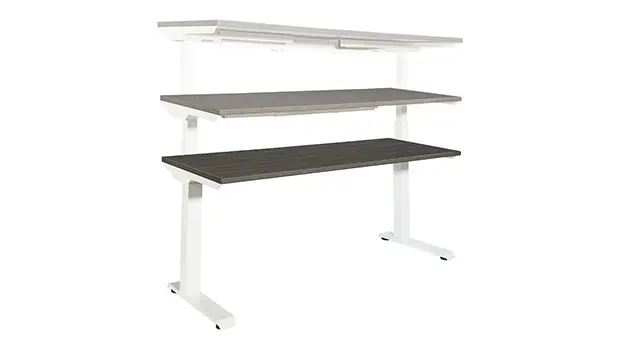
Electric Height Adjustable Standing Desk 60in W x 30in D by Office Star
View & OrderThe converter is genuinely the right call in a few situations. If you're not sure whether you'll actually use a sit-stand setup, the converter is a low-risk way to find out without replacing your whole desk. If you're in a leased space and can't take a sit-stand desk with you when you move, a converter is easy to pack up. If budget is tight and you're choosing between a converter now versus saving for a proper sit-stand desk later, the converter gets you started. Just be realistic about its limitations — it's not a full substitute for a height-adjustable desk if you want a complete, comfortable standing workspace.
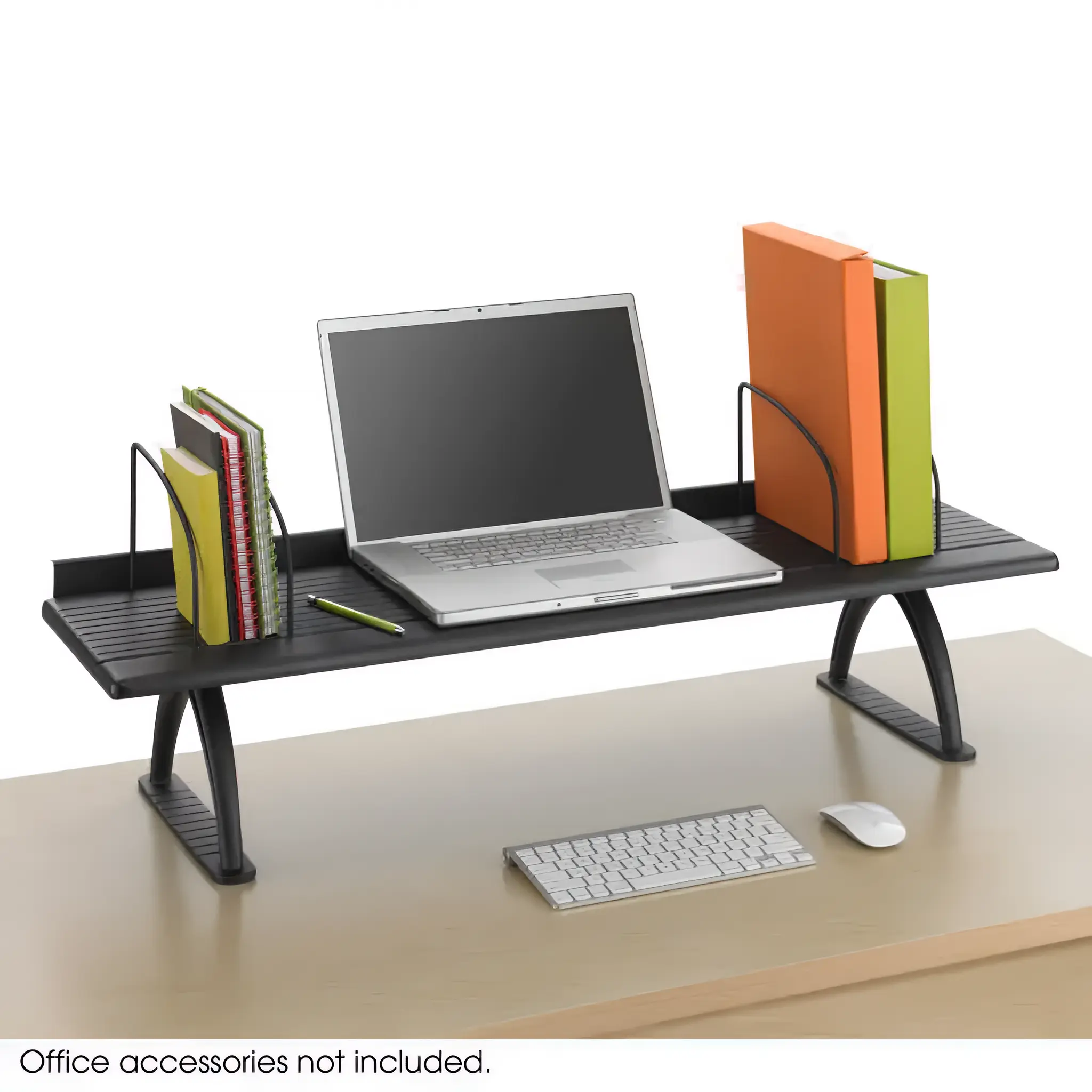
Adjustable Height Desk Converter by Safco Products
View & OrderDesk converters start at a fraction of what a sit-stand desk costs — that's a real advantage, and it's honestly the reason many buyers start there. But consider the complete story: if you use a converter and love the sit-stand workflow, you'll very likely end up buying a proper sit-stand desk anyway. If that's likely to happen, it might make more financial sense to skip the converter and invest directly in the desk. On the flip side, if you're not sure you'll use standing work regularly, paying for a full sit-stand desk upfront is risky. The converter earns its value as a low-commitment starting point or a permanent solution for users with simple, contained setups.
Whichever option you choose, a few setup details make a big difference. An anti-fatigue mat under your feet while standing dramatically reduces the fatigue that otherwise builds up in 20–30 minutes of standing — this matters whether you have a full sit-stand desk or a converter. Position your monitor so your eyes hit the top third of the screen while standing, not looking down. Keep your keyboard and mouse at a height where your elbows can stay close to 90 degrees. And don't stand all day — the research consistently shows that alternating between sitting and standing in roughly 30–60 minute intervals is better than either extreme. The desk is just a tool; how you use it determines whether you actually feel the benefit.
If you know you'll use sit-stand functionality daily and you want the real experience, go with the electric sit-stand desk — it's a genuinely worthwhile investment that'll change your working day. If you're testing the concept, working in a temporary space, or managing a tight budget, the desk converter is a smart starting point. Either way, FindOfficeFurniture.com has you covered with free shipping and a Lifetime Warranty. Give us a call and we'll help you find the right fit.
Shop Desks at FindOfficeFurniture.comA sit-stand desk is a full desk replacement — the entire desktop surface adjusts from seated to standing height via an electric motor. A desk converter sits on top of your existing desk and raises a smaller platform (usually 28–40 inches wide) to standing height. The sit-stand desk gives you the full desk surface at every height; the converter gives you a smaller elevated workspace while the rest of your existing desk stays fixed.
A desk converter is a good short-to-medium-term solution, especially for testing whether you'll actually use a sit-stand setup before committing to a full desk purchase. Most people who use their sit-stand functionality daily find that a dedicated electric sit-stand desk is more comfortable — the full desktop is available at every height, there's no crowded platform, and the ergonomics are cleaner. For budget-conscious buyers or leased spaces, converters remain a solid option.
Most desk converters occupy 28–40 inches of width on your existing desk surface. When raised, the converter sits in front of you and consumes depth in that zone as well. This works fine for a single laptop or one monitor, but users with dual monitors, a keyboard, and a phone can find the raised platform crowded and the non-elevated desk area inconvenient to reach while standing.
Sit-stand desks integrate well with desk-mounted monitor arms, CPU holders, and under-desk cable management trays — all of which move with the desk as it adjusts. Anti-fatigue mats also work naturally. Desk converters are awkward with monitor arms and cable management since the desk surface beneath the converter is fixed.
Electric sit-stand desks need a standard power outlet for the motor. Plan for an accessible outlet near the desk location — ideally not one requiring a cord across a walking path. Budget for cable management as part of the setup. Manual crank models don't need power, but electric is the more practical choice for anyone planning to adjust height multiple times a day.