
- Menu
- Desks
- Seating
- Tables
- Customer Service
- 1.888.719.4960
Both give you more workspace than a straight desk — but they serve pretty different types of users. Here's how to tell which one actually fits your room, your role, and your budget.
Quick Verdict
The L-shaped desk is the right pick for most offices — it delivers serious workspace, plays well with accessories, and fits in rooms that aren't enormous. The U-shaped desk is a power-user setup that earns its footprint and price only when you'll genuinely fill all three sides every day. If there's any doubt about room size or workflow, go with the L-desk and don't look back.
| Feature / Factor | L-Shaped Desk | U-Shaped Desk |
|---|---|---|
| Typical Dimensions | 60"–72" main run + 42"–48" return | 66"–72" wide with two returns wrapping both sides |
| Approx. Weight | 140–240 lbs | 220–350 lbs for full commercial configurations |
| Best For | Two-zone daily workflows — screen work plus paperwork or reference | Executives and power users needing separate zones for meetings, tech, and storage |
| Main Advantage | Generous surface without the scale and cost of a full executive suite | Maximum continuous workspace and commanding office presence |
| Main Trade-Off | Needs adequate wall length and planning ahead for delivery | Requires the largest room and can feel oversized in modest spaces |
| Accessory Fit | Works with pedestals, hutches, monitor arms, cable management | Pairs naturally with hutches, pedestals, tackboards, and visitor seating |
| Installation | Multi-component but manageable with planning | More involved — multiple boxes, careful measuring required |
| Minimum Room Size | 8’ × 8’ clear working area | Ideally 10’ × 12’ or larger |
| Visual Feel | Professional and substantial without feeling overwhelming | Executive and architectural — commands attention |
| Long-Term Value | Excellent for private offices and serious home workspaces | High value only when the office and role genuinely justify the scale |
The gap between an L-desk and a U-desk comes down to whether you need two active surfaces or three. An L-shaped desk wraps one corner and gives you a primary surface plus one return — that's enough for most office setups, including multi-monitor rigs, paperwork-heavy roles, and shared workstations that see heavy daily use. You have a dedicated computer zone and a secondary work zone, and that setup handles a remarkably wide range of jobs.
A U-shaped desk adds the second return, which creates a three-sided work environment where the person sitting at it is essentially surrounded by workspace. That's genuinely useful for executives who hold sit-down meetings across the desk, for roles that require simultaneous access to three distinct work areas, or for offices where the desk itself serves as a visual anchor for the whole room. But that capability comes with real trade-offs: the room needs to be significantly larger, the desk weighs more and ships in more pieces, and the price is substantially higher. It's a great desk for the right situation — but overkill for most.
If you're setting up a private office, a dedicated home workspace, or a manager's office in a commercial building, the L-shaped desk covers your needs at a much friendlier price and footprint than the U-desk. You get plenty of surface for a dual-monitor setup, paperwork, a phone, and a coffee, and you're not committing an entire room to a single piece of furniture. L-shaped desks also integrate cleanly with popular accessories — a pedestal on one side, a monitor arm overhead, a hutch above — without looking thrown together. And at 8 feet by 8 feet of minimum room space, they fit in a wide range of private offices.
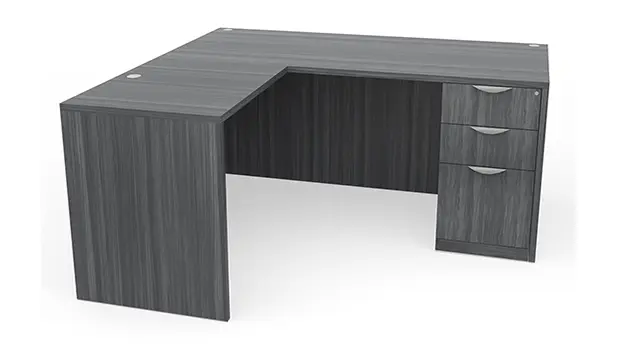
L-Shaped Desk 66in W x 66in D with Hutch by PBD Furniture
View & OrderThe U-shaped desk earns its price and footprint when your role demands it. That means you're regularly using three distinct work zones in the same session — not just theoretically, but actually sitting there and working across all three surfaces every day. It also makes sense for executive offices where the desk needs to project authority and accommodate visitor seating comfortably. When clients walk into a well-furnished U-desk office, they notice. That presence has real value in the right setting.
One thing to be honest about: a lot of U-shaped desks end up with two active surfaces and one that collects mail and coffee cups. If that sounds like your working style, save yourself the money and the room real estate and get a well-configured L-desk instead. The best desk is the one you actually use, not the most impressive one in the catalog.
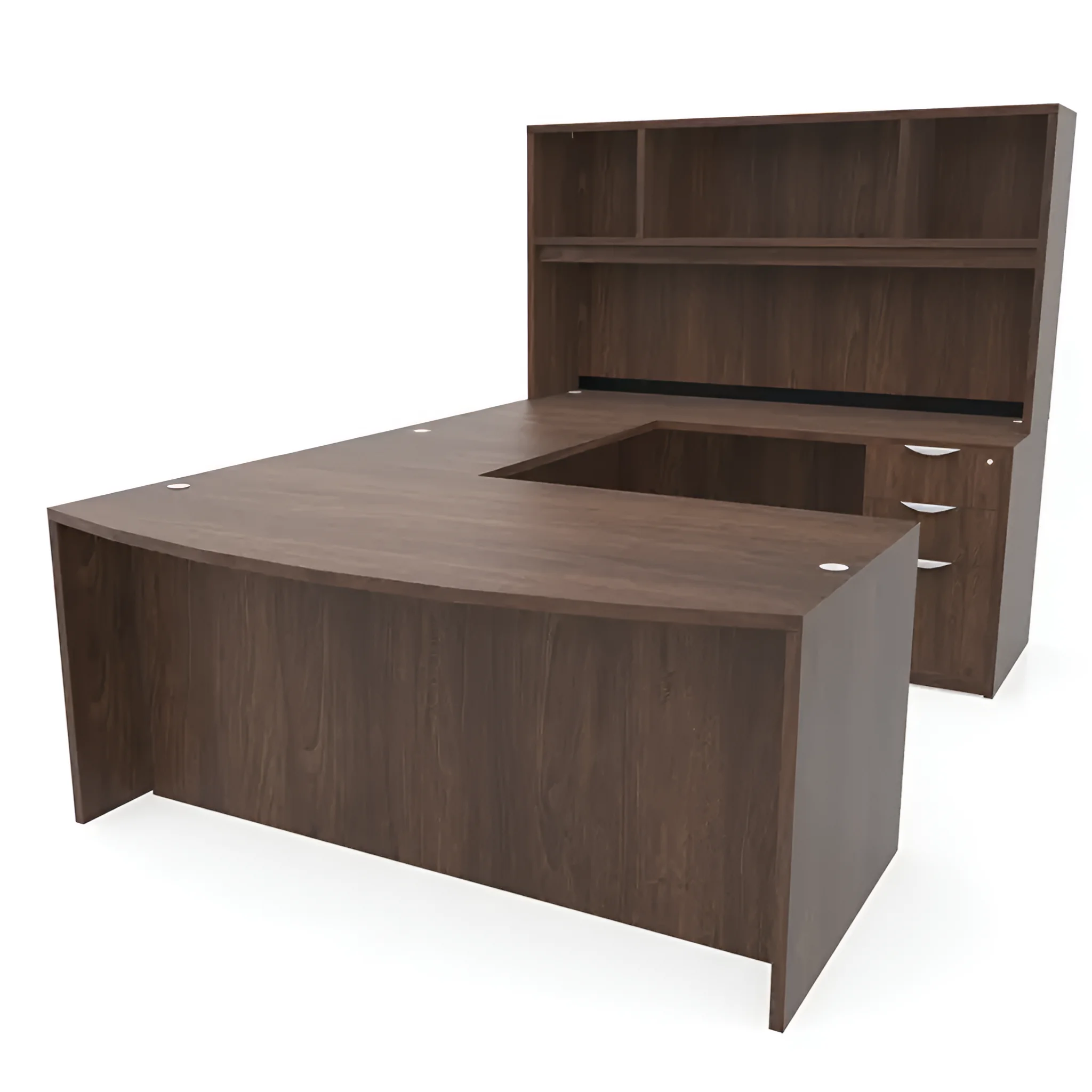
U-Shaped Desk 119in W x 87in D by Office Star
View & OrderL-shaped desks start lower and top out well below what most U-shaped desk configurations cost. That gap is real and meaningful, but it's worth thinking through carefully before you default to whichever option looks cheaper. If you buy an L-desk and find yourself constantly wishing you had more surface — adding folding tables, a credenza, or other workarounds — the cumulative spend can end up higher than a U-desk would have been. Price the whole room, not just the main piece. At FindOfficeFurniture.com, free shipping is already included, so the price you see is the price you pay.
An L-shaped desk needs a minimum of 8 by 8 feet of clear working area to feel right — that's the desk plus chair clearance and a walking path around it. A U-shaped desk needs considerably more, with 10 by 12 feet being a practical minimum for commercial configurations. Before you fall in love with a U-desk in the catalog, measure your room carefully: length, width, and the positions of doors, windows, and HVAC vents. A desk that looks great on a spec sheet but turns your office into an obstacle course isn't actually a good buy at any price. If you're not sure whether your room can handle either option, call us — we're happy to talk through the layout with you.
For most buyers — home offices, private corporate offices, and manager setups — the L-shaped desk is the smarter choice. It delivers plenty of surface area, fits in a wider range of rooms, accepts all the accessories you'd want, and comes at a much more comfortable price point. Step up to the U-shaped desk only if your workflow genuinely demands three working zones and your room can support the footprint without feeling cramped. Shop both at FindOfficeFurniture.com or call us to talk through finishes, sizes, and matching pieces.
Shop Desks at FindOfficeFurniture.comAn L-shaped desk gives you a primary work surface with one return wing — two sides total. A U-shaped desk adds a second return, wrapping around both sides for a three-sided working environment. The U-shaped desk gives you significantly more surface area and the ability to dedicate separate zones to different tasks, but it requires a much larger room and a bigger budget.
U-shaped desks really need a private office that's at least 10 feet by 12 feet — ideally more. You need room for the desk footprint (often 66–72 inches wide with two side returns), plus adequate chair clearance on all open sides, walking aisles, and visitor seating space. If the room feels tight with an L-desk, a U-desk will feel overwhelming.
For most home offices, yes — unless you're running a genuine multi-screen workstation with multiple active tasks, a content production setup, or a business requiring dedicated zones for meetings and equipment. The L-shaped desk handles the vast majority of home office needs at a lower price and with a much smaller footprint. Save the U-desk for power users who'll fill all three sides daily.
L-shaped desks are the simpler project — fewer boxes, fewer components, and a more manageable assembly. U-shaped desks involve more pieces, more weight (220–350 lbs is typical), and require careful room measuring well before delivery day. Both can be done, but the U-desk is more of a planned installation than a quick setup.
It makes sense when you'll consistently use all three surfaces, when your role requires dedicated technology, meeting, and storage zones, or when the office environment benefits from the presence a U-desk brings. If you're not regularly filling two wings with productive work, the L-shaped desk gives you a better return at a lower investment.