
- Menu
- Desks
- Seating
- Tables
- Customer Service
- 1.888.719.4960
This one comes down to desk height. Get that right and the chair choice is easy. Get it wrong and you're fighting your workstation every single day.
Quick Verdict
If your work surface is at standard desk height (28–30 inches), use a standard office chair. If you're working at a counter, drafting table, lab bench, or elevated sit-stand desk, use a drafting chair. These chairs are engineered for specific height ranges — putting the wrong one at your workstation creates ergonomic problems that no amount of adjustment will fix.
| Feature / Factor | Drafting Chair | Office Chair |
|---|---|---|
| Seat Height Range | 22"–32" — designed for elevated surfaces | 17"–21" — fits standard desk heights |
| Approx. Weight | 30–55 lbs | 25–55 lbs |
| Best For | Drafting tables, counter-height stations, lab benches, elevated sit-stand setups | Standard desk work across the broadest range of offices |
| Main Advantage | Bridges the gap between chair height and elevated work surfaces | Fits normal desk heights without special adaptation |
| Main Trade-Off | Too tall and specialized for normal desk use | Cannot serve elevated counters or drafting tables effectively |
| Footring | Essential — supports legs when feet can't reach the floor | Not applicable — feet rest on the floor at standard height |
| Ergonomic Features | Best when it includes footring, lumbar support, and seat-depth adjustment | Broadest range of ergonomic and style options across all types |
| Assembly | Standard — pay attention to cylinder and footring height | Very straightforward |
| Visual Profile | Purpose-built and technical | Versatile and familiar |
| Long-Term Value | Excellent for the right application — poor if mismatched to desk height | Excellent for the most common use case |
Most office chairs are built around a standard desk surface at 28 to 30 inches high. The cylinder height, seat range, and armrest positions are all calibrated so that when you're sitting at a standard desk, your elbows land at roughly desk height and your feet sit flat on the floor. That's the ergonomically correct posture for standard desk work, and a standard office chair delivers it reliably.
A drafting chair has a longer cylinder that pushes the seat up to 22–32 inches, sometimes higher. The footring — which circles the base above the casters — acts as a floor substitute, supporting your legs when your feet can't reach the ground. This is the right setup for a drafting table at 36 to 42 inches high, a counter-height workstation, a medical exam station, or a sit-stand desk you prefer to use at an elevated seated position rather than at standard desk height.
Putting a drafting chair at a standard desk creates immediate ergonomic problems — your arms sit too high relative to the desk surface, your posture tilts, and you'll feel it in your neck and shoulders within a day. The reverse — using a standard office chair at a counter or drafting table — forces you to hunch or reach upward. Neither is tolerable long-term. Match the chair to the surface height and you avoid both problems entirely.
The drafting chair is purpose-built for a specific set of applications: architectural or design workstations with elevated drawing surfaces, counter-height work areas in labs, clinics, or industrial environments, or any sit-stand desk setup where you want to work seated at a raised surface height rather than at a traditional seated desk position. If you have one of these situations, the drafting chair isn't optional — it's the ergonomically correct solution.
When shopping for a drafting chair, prioritize models that include an adjustable footring rather than a fixed one, seat depth adjustment, and at minimum a functional lumbar contour. The elevated seated position creates a slightly different load on your lower back than standard desk seating, so good lumbar support matters even more at drafting height than it does at standard desk height.
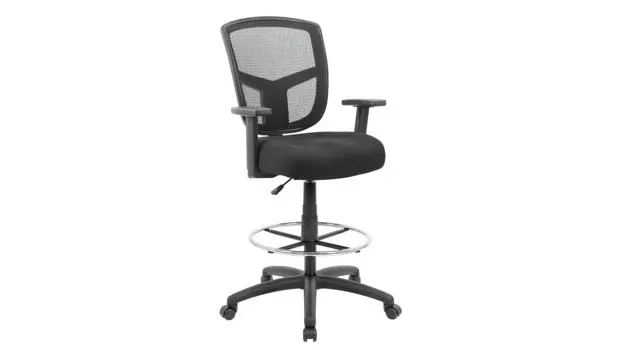
Drafting Chair with Adjustable Footring by Boss Office Products
View & OrderThe standard office chair is the right choice for the overwhelming majority of office environments — anywhere the work surface is at standard desk height. It's the universal solution for a reason: the height range, ergonomic feature set, and adjustability options are all optimized for the most common seating application in the world. Unless you have a specific elevated work surface that requires a drafting chair, a well-specified office chair will serve you better in every respect.
Standard office chairs also offer the widest selection of ergonomic features, materials, and price points of any chair category. From basic task chairs for open-plan settings to high-end ergonomic models with full lumbar systems, adjustable headrests, and synchro-tilt mechanisms, the category covers more ground than drafting chairs ever could. If you're working at a regular desk, start here.
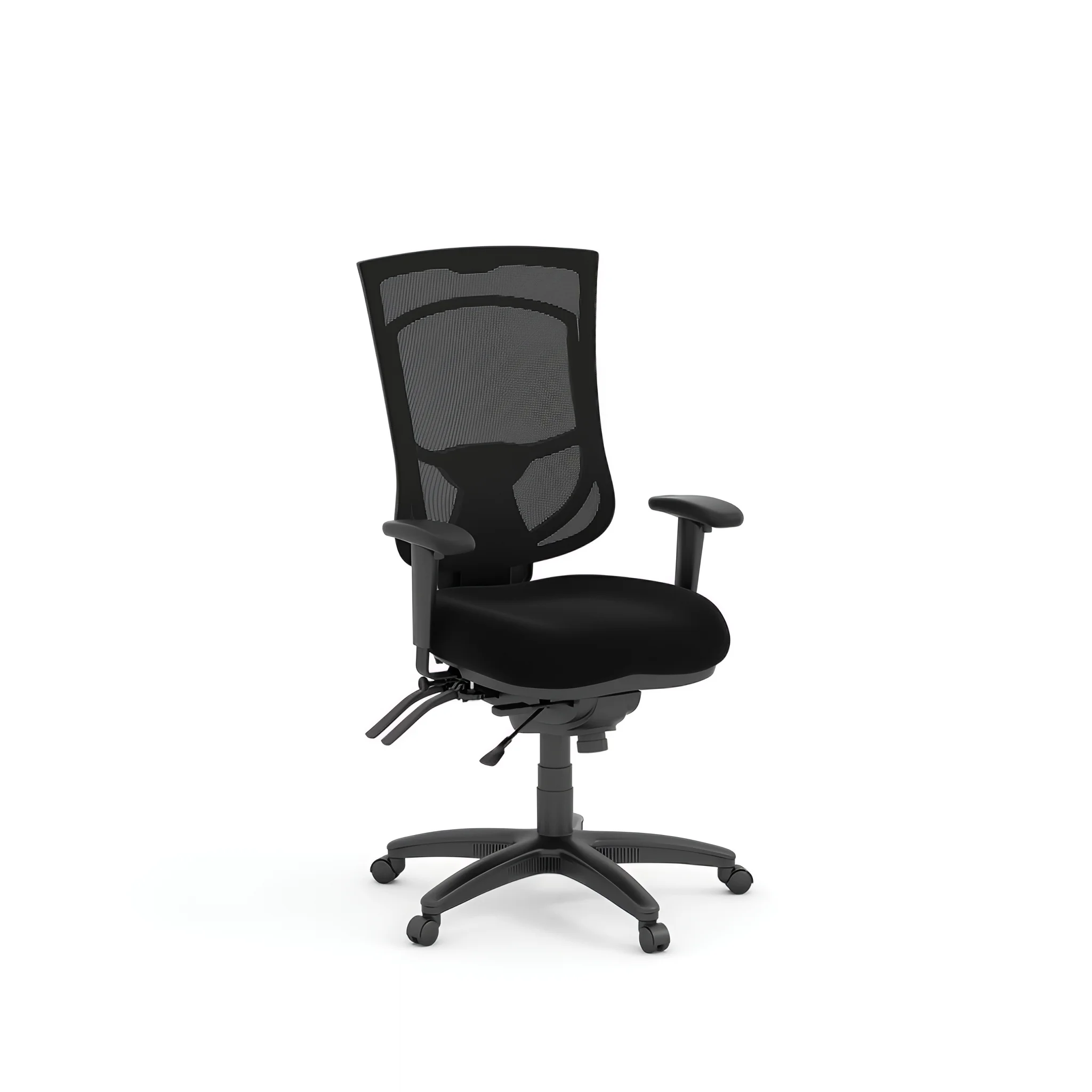
Ergonomic Task Chair Mesh Back Seat by PBD Furniture
View & OrderBefore you order either chair, measure your actual work surface height. Standard desks run 28 to 30 inches. Counter-height surfaces are typically 34 to 36 inches. Drafting tables range from 36 to 42 inches or more. If your surface is below 32 inches, a standard office chair will serve you. If it's above 32 inches, you need a drafting chair — and you should confirm the drafting chair's seat-height range actually reaches your target working height before ordering.
Also confirm that the drafting chair you're considering includes a footring. It's not a nice-to-have — it's ergonomically necessary whenever your feet can't comfortably reach the floor. Our team has helped hundreds of buyers work through exactly this kind of specification question. Call us and we'll make sure you get the right chair for your exact setup.
The right chair here is entirely determined by your desk height. For standard office desks, the standard office chair is the better choice across every dimension — more options, better ergonomics, easier specification. For counter-height stations, drafting tables, and elevated sit-stand setups, the drafting chair is the only viable solution. Don't try to adapt the wrong one — buy the right one for your surface height and you'll be comfortable from day one. Browse all office seating at FindOfficeFurniture.com or give us a call to talk through what your specific workstation needs.
Shop Seating at FindOfficeFurniture.comThe defining difference is seat height range. A standard office chair adjusts between roughly 17 and 21 inches from the floor — the right range for a standard desk surface at 28 to 30 inches high. A drafting chair uses a taller gas cylinder that extends the seat to 22–32 inches or higher, with a footring to support your legs when your feet can't reach the floor. Drafting chairs exist specifically for elevated work surfaces: drafting tables, counter-height stations, lab benches, and standing desks used in a seated-but-raised mode.
You can lower a drafting chair to its minimum height, but on most models that still puts the seat at 22–24 inches — several inches higher than the top of a standard desk. That mismatch forces an uncomfortable arm position and puts your wrists at the wrong angle. A drafting chair at a standard desk isn't a workable long-term solution. If your workstation is at standard desk height (28–30 inches), a standard office chair is the right tool.
Yes — a footring isn't optional on a drafting chair, it's ergonomically essential. When your seat is at 24–30 inches and your feet can't reach the floor, your legs need something to rest on. Without a footring, all that hanging weight pulls down on your lower back and thighs, creating fatigue and discomfort within an hour. A good drafting chair includes a height-adjustable footring so you can position it correctly for your leg length. If a model doesn't include a footring, skip it regardless of how good the seat looks.
Yes — this is one of the best applications for a drafting chair. When you lower your sit-stand desk to a raised seated position (say 40–45 inches), a drafting chair lets you work comfortably at that elevated height. The footring supports your legs, the seat adjusts to the right level, and you get the ergonomic benefits of being slightly more upright than a traditional seated position. Make sure the drafting chair's seat-height range overlaps with your desk's preferred elevated-seated height before ordering.
Not effectively. A standard office chair at its maximum height still puts the seat 3 to 6 inches too low for most counter-height surfaces. Working at a too-low seat forces you to hunch or raise your arms unnaturally, which strains the neck, shoulders, and upper back over time. If you have a counter-height station, a lab bench, or a drafting table, you need a chair specifically designed to reach that height range. A drafting chair is the right tool — a standard chair at maximum extension is a workaround that creates ongoing ergonomic problems.