
- Menu
- Desks
- Seating
- Tables
- Customer Service
- 1.888.719.4960
Your reception desk is the first thing clients see when they walk in. Getting the configuration wrong means your receptionist is cramped, your lobby looks off, or both. Here's a straightforward comparison to help you pick the right one.
Quick Verdict
If your front desk handles real volume — calls, visitors, packages, computer work — the L-shaped station gives your receptionist room to do the job without turning it into a juggling act. If your lobby is compact or your front desk role is straightforward, a straight reception desk delivers a clean, professional look without overpowering the space. Measure first, then decide.
| Feature / Factor | L-Shape Reception Desk | Straight Reception Desk |
|---|---|---|
| Typical Width | 72"–96" main run + return wing | 60"–96" single linear footprint |
| Approx. Weight | 180–320 lbs | 120–240 lbs |
| Best For | High-traffic front desks managing visitors, phones, packages, and computer tasks simultaneously | Smaller lobbies and front-desk roles with focused, lighter workflow |
| Main Advantage | Dedicated guest-facing and staff-facing zones with strong operational control | Fits more easily into compact lobbies and keeps sightlines open |
| Main Trade-Off | Needs more lobby square footage; can overpower a small entry | Less back-side zoning; less wraparound workspace for busy shifts |
| Storage Options | Excellent for transaction tops, lockable storage, and two-person workflows | Works well with a transaction counter and modest storage |
| Installation | Multi-component; plan alignment and power access before delivery | Simpler install — fewer pieces, lighter components |
| Visual Impact | Substantial and commanding — reads as a serious professional station | Streamlined and welcoming — keeps the lobby feeling open |
| Minimum Lobby Size | Best in lobbies 12’ wide or more | Works comfortably in lobbies starting around 8’–10’ wide |
| Long-Term Value | High when the front desk is a genuine full-time workstation | Strong for lobbies that need polish without bulk |
An L-shaped reception desk is really two surfaces working together. The main run faces the guest approach and gives your receptionist the transaction surface they need for check-ins and visitor sign-ins. The return extends behind or beside that surface and creates a separate work zone — computer, phone, mail sorting, whatever the daily workflow demands. Those two zones don't bleed into each other, which is what makes a busy front desk manageable rather than chaotic.
A straight reception desk is a single surface doing all of that work in a cleaner, more compact form. It looks sharp, it fits more lobby types, and it's straightforward to install and maintain. The limitation shows up when the role demands more than one thing at a time — there's only so much you can stage on a linear surface before it starts to feel cluttered, and there's no natural separation between what guests see and what the receptionist needs to access.
If your receptionist is on the phone while greeting a visitor while handling a package delivery, the L-shaped station gives them the room to actually do that. The return provides a private work zone that guests don't see and don't interfere with — and that separation makes a real difference over the course of a full workday. The L-shape is also the right call when you're adding a second person to the station occasionally, or when your workflow includes lockable storage and cable management that needs clean routing.
One honest caveat: the L-shape needs the lobby to support it. Don't force it into a space where it eats up visitor seating, blocks pathways, or makes the entry feel like an obstacle course. If the lobby isn't big enough to let the desk breathe, the straight model will look more intentional and feel more welcoming.
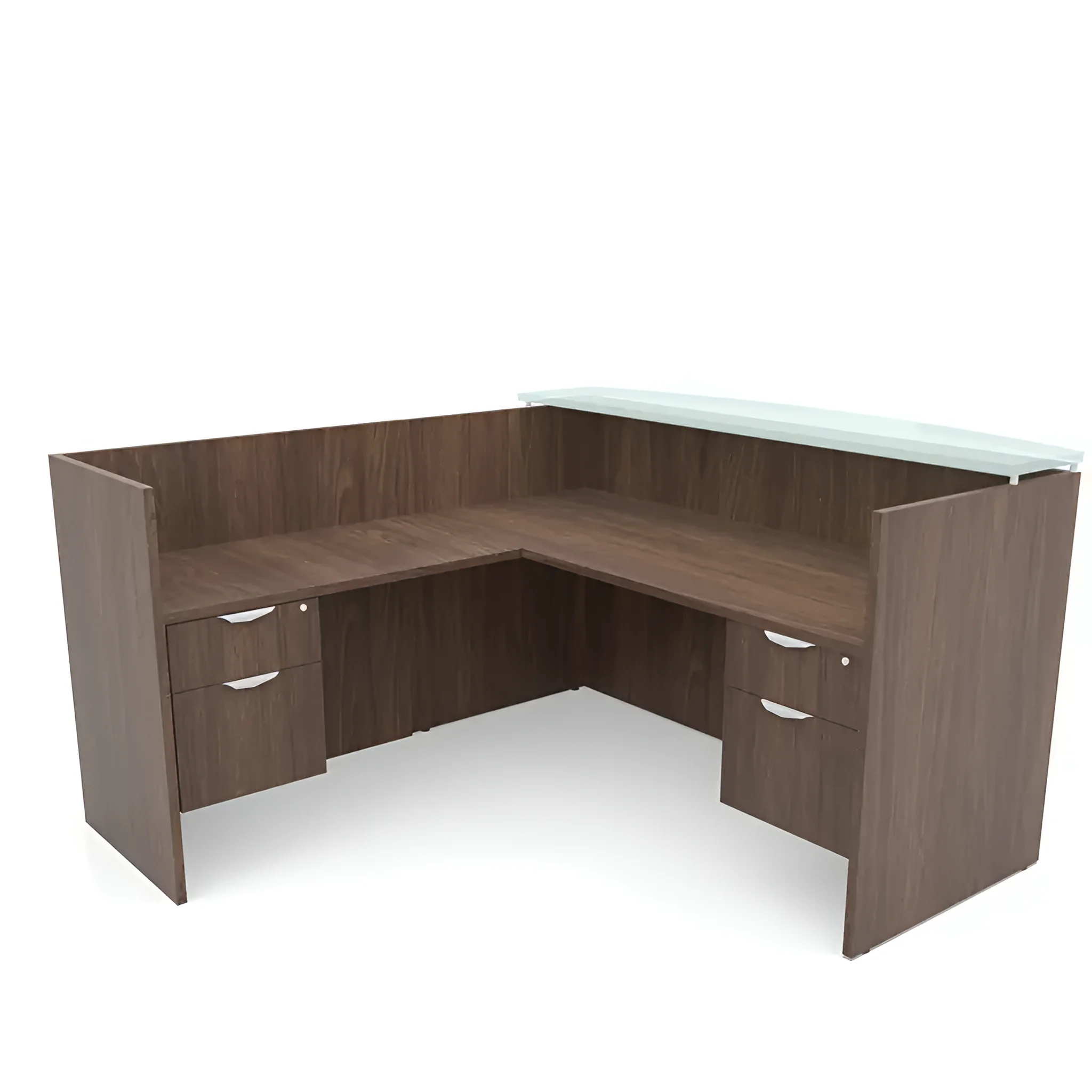
L-Shape Reception Desk 108in W x 96in D by Office Star
View & OrderThe straight reception desk earns its place in any lobby where a clean, open, professional look is more important than maximum operational surface. Compact lobbies, medical waiting rooms, salon check-in areas, and boutique retail fronts all benefit from the straight desk's ability to present well without demanding space it doesn't have. It's also the faster installation, the lighter delivery, and the easier model to reposition if you refresh the lobby layout.
Don't treat the straight desk as the budget option or the fallback — in the right lobby, it's simply the better specification. A well-chosen straight reception desk with a transaction top and matching storage cabinet can make a lobby feel polished and intentional in a way that a too-large L-shape never could.
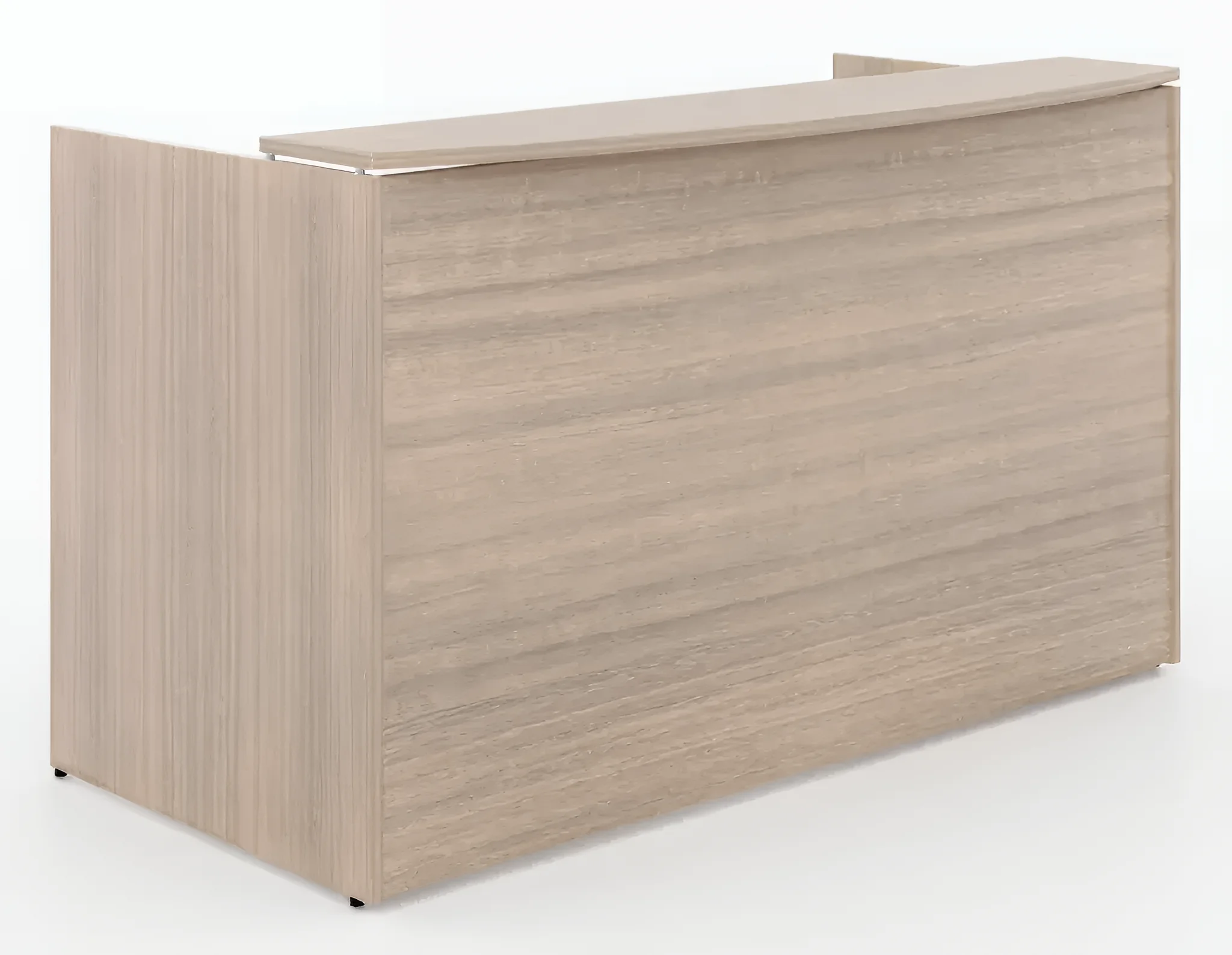
Reception Desk with Hutch by Corp Design
View & OrderL-shaped reception stations come in at a higher starting point than straight desks, reflecting the additional components, the heavier frame, and the more involved installation. But before you default to the straight model on cost alone, think through what the L-shape delivers in terms of daily productivity. A receptionist who has the room to work efficiently without constantly clearing the transaction top is a real operational benefit — and that's a hard cost to quantify after the fact.
We always recommend budgeting for the complete setup — desk, transaction top if applicable, matching storage, and any cable management — rather than just the main piece. Free shipping at FindOfficeFurniture.com means you're looking at the real all-in number the moment you see the product listing.
The most common mistake we see with reception desk purchases is ordering before measuring. Pull the tape on your entry: note the distance from the main entrance to the desk position, the width of the lobby, the location of any electrical outlets or data ports, and the clearance your receptionist needs to move behind the station. For L-shaped desks, that back clearance is especially important — the return wing needs room to function, and a desk pinned against a side wall doesn't work the way it's intended.
Also think about your visitor circulation path. Guests should be able to approach the desk clearly, complete their check-in, and move toward seating or an interior door without walking through the receptionist's work zone. A well-planned desk position makes that natural. If you'd like help laying out the space before you commit, our team has been doing this for over 30 years — give us a call.
For active front desks in lobbies with room to support it, the L-shaped reception station is the more capable and long-term-efficient choice. For smaller lobbies or roles with simpler demands, the straight reception desk is the smarter, cleaner specification that won't leave you second-guessing the footprint. Either way, buy for the actual workflow and the actual room — not for what looks impressive in a catalog photo. Browse reception desks at FindOfficeFurniture.com or call us and we'll help you get the size and configuration exactly right.
Shop Reception Desks at FindOfficeFurniture.comAn L-shaped reception desk creates two distinct zones — a guest-facing transaction side and a staff-facing work area — so the receptionist can handle visitors, calls, packages, and computer work without constantly shuffling things around on a single surface. The return panel also gives the receptionist a sense of enclosure that helps them stay organized during a busy front desk shift. If your reception involves multiple simultaneous tasks, the L-shape earns its footprint.
A straight reception desk is the right choice when the lobby is compact, when visitor traffic is light, or when the front desk role is focused and singular — greeting people and directing them without heavy administrative work. It also looks cleaner in a narrow lobby where an L-shape would dominate the sightlines or create traffic flow problems. The straight desk gives you a professional, welcoming surface without the footprint overhead.
Plan on at least 10 to 12 feet of clear wall space along the main run, plus 6 to 8 feet for the return wing. You also need 3 to 4 feet of clear zone behind the desk for the receptionist's chair, movement, and any storage drawers that swing out. Lobbies smaller than roughly 12 by 14 feet often feel cramped with an L-shaped station — the straight desk is usually the better fit in tighter entry areas.
Yes — many straight reception desks are available with an optional raised transaction top along the guest-facing side, which adds a professional barrier between the visitor and the work surface. That feature closes the functional gap between straight and L-shaped models for lighter workflow environments. If you need a transaction counter but don't need the full return wing, a straight desk with a raised top is a smart, space-efficient solution.
Straight reception desks are simpler to install and usually arrive in fewer components — two to four pieces is typical. L-shaped reception stations involve more pieces, often 6 to 10 components, and require careful alignment at the corner section. For L-shaped configurations, having two people for installation and a clear plan for the electrical access and wire routing will save you real time. If you're not comfortable with the assembly process, professional installation is a worthwhile investment for any reception desk that serves as your company's first impression.