
- Menu
- Desks
- Seating
- Tables
- Customer Service
- 1.888.719.4960
Two desks that can look nearly identical in a catalog photo but feel completely different once someone sits across from you. Here's the honest rundown so you pick the right shape the first time.
Quick Verdict
If you regularly meet with clients or colleagues from behind your desk, the bow front is worth the investment — that curve is purpose-built for face-to-face interaction. If you work solo most of the day or need to fit a desk into a tighter room, the straight desk wins on flexibility, budget, and ease of placement. Know your daily workflow and the choice becomes obvious fast.
| Feature / Factor | Bow Front Desk | Straight Desk |
|---|---|---|
| Typical Width | 66"–72" with a curved front edge | 60"–72" with a flat, uniform front |
| Approx. Weight | 130–220 lbs | 100–190 lbs |
| Best For | Executive and managerial offices with regular visitor interaction | Solo-focused work where efficiency and footprint matter most |
| Main Advantage | Softer, more welcoming front edge that draws visitors in | Fits rooms more predictably and typically costs less |
| Main Trade-Off | Uses more room depth than a straight-front alternative | More utilitarian feel; less guest-oriented in executive settings |
| Storage & Accessories | Pairs naturally with pedestals, bridges, and matching storage | Easy to accessorize; works well alongside returns or credenzas |
| Installation | Similar process, but placement needs more planning | Simple to measure, install, and relocate |
| Visual Feel | Refined and hospitality-oriented | Structured and efficient |
| Room Flexibility | Best when the front curve has space to breathe | Ideal where room depth is limited or layout changes often |
| Long-Term Value | Excellent when front-of-desk interaction is part of the job | Strong where function and footprint outrank presentation |
The core difference is the front edge — and what that edge does for you every day. A bow front desk curves outward toward the user and toward any visitors seated across from it. That gentle arc gives you more usable depth at the center of the desk and naturally positions guests at a slight angle that feels less confrontational than sitting square against a flat wall of furniture. In executive suites, conference rooms, and private offices where meeting people is part of the job, that distinction matters.
A straight desk keeps everything in a clean, rectangular line. There's nothing wrong with that — in fact, for most work that doesn't involve sitting across from someone, the straight desk is the sharper choice. It fits predictably, it's easier to move if the room changes, and it leaves more options open when you're accessorizing the workstation. The bow front is a design choice that delivers a specific kind of workplace experience. The straight desk is a design choice that stays out of your way and lets the work lead.
The bow front desk earns its spot in offices where the desk itself is part of the impression. If you're meeting with clients, conducting reviews, or regularly having conversations with people seated across from you, the curve does real work. It brings people physically closer to you without feeling crowded, and it signals a level of intentionality that a flat-front desk just doesn't carry. Pair it with matching pedestals and a hutch and you've got a full executive workstation that looks cohesive, not just assembled.
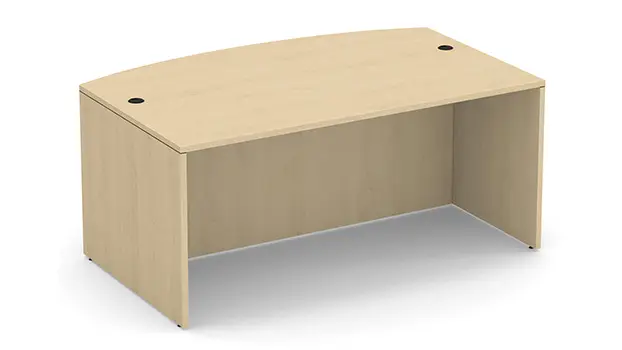
Bow Front Desk 66in W x 30in D by PBD Furniture
View & OrderDon't write off the straight desk as the boring option — in a lot of offices it's simply the right tool for the job. If you're heads-down on work most of the day, rarely have visitors seated at your desk, or need a piece that's easy to fit into multiple room configurations over time, the straight desk delivers on every front. It's also the better call when room depth is limited, because you won't be fighting the curve for clearance. At FindOfficeFurniture.com we carry straight desks in a wide range of sizes and finishes, so you're not settling — you're specifying precisely what your room needs.
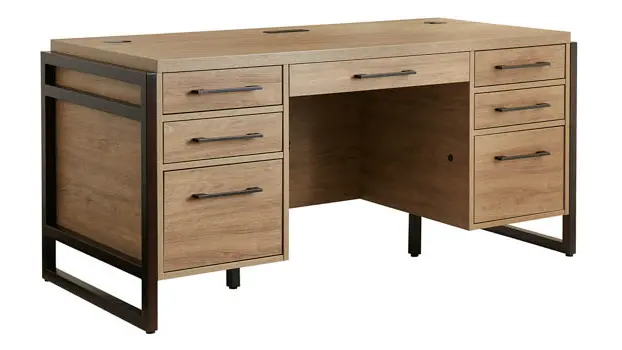
Writing Desk 60in W x 30in D by Martin Furniture
View & OrderBow front desks typically run higher than comparable straight desks. But the cost conversation doesn't end at the sticker. If you buy a straight desk and find yourself wishing you had more front-of-desk presence for client meetings — or if the room feels less polished than you hoped — you've made a decision that costs more in the long run. On the flip side, if you spend up for the bow front and rarely sit across from anyone, you've paid a premium for a feature that never gets used. Think honestly about your daily routine, price the complete workstation including storage and accessories, and then decide. Free shipping at FindOfficeFurniture.com means no shipping surprises at checkout.
Before you order, pull out a tape measure and map the room. A bow front desk needs enough space in front of the curved edge for comfortable chair movement and for a visitor to sit without feeling boxed in — plan for at least 4 to 5 feet of clearance between the front of the desk and any wall or furniture opposite it. Straight desks are more forgiving on that front. With either option, account for your door swing, any nearby storage pieces, and how traffic moves through the room. A desk that looks perfect in isolation can create awkward circulation patterns once the full room is furnished.
If you're not sure which shape will work better in your specific space, give us a call. We've been helping people plan office rooms for over 30 years and we're happy to work through dimensions with you before you commit.
For offices where meeting people is a regular part of the job, the bow front desk is a genuine upgrade over a flat-front alternative — the interaction benefit is real and the workstation looks purposefully designed. For offices focused on personal productivity and efficient room use, the straight desk is the stronger call. Both are well-represented at FindOfficeFurniture.com in the sizes, finishes, and configurations that fit real offices. Shop desks online or call us and we'll help you land on the right piece.
Shop Desks at FindOfficeFurniture.comThe bow front desk has a gently curved front edge that extends the working surface toward you — and toward anyone seated across from you. That curve gives you slightly more usable depth at the center of the desk and creates a more open, welcoming feel for visitors. A straight desk keeps a flat, uniform front line that's easier to place in a room and often costs less. If you meet with people from behind your desk or want a more executive presentation, the bow front pays off. If your work is solo and efficiency matters more than impression, the straight desk is the smarter, cleaner pick.
Yes, modestly. The curved surface extends a few inches further from the wall than a comparable straight desk, so you need more clearance in front. Straight desks fit more predictably in tighter rooms. Measure carefully and account for that extra bow depth before ordering.
Absolutely. Bow front desks accept the same storage accessories as traditional executive desks — box/file pedestals, return units, and bridges all pair well. The curved front doesn't affect the back edge or side compatibility. Straight desks are equally accessory-friendly and often easier to pair with returns placed flush against the side.
Straight desks have the edge here. Their flat front profiles fit into more room configurations, and their simpler shape makes measuring future spaces fast. Bow front desks aren't difficult to move, but their curved front means some layouts that work for a straight desk won't work as well. If your floor plan changes often, the straight desk gives you more flexibility.
If your office involves regular face-to-face meetings, yes. The curve is purpose-built for interaction — it draws people in rather than keeping them at a flat wall of desk. For private offices where visits are rare and you mostly work solo, the extra investment is harder to justify. Think about how you actually use your desk day-to-day, and the right answer becomes clear. Free shipping at FindOfficeFurniture.com means the price you see is what you pay either way.